
Why Is Medicai the Best for Advanced 3D/4D Viewing?
Many radiologists still switch between two or three different tools just to open a 4D cardiac sequence that arrived from another hospital. Each switch costs minutes that add up across a day of reading lists. The number of sites that need to collaborate on a single case keeps rising, yet the tools meant to help rarely keep up.
By the end of this article you will know how Medicai's zero-footprint viewer, cloud PACS, and AI tools combine to handle those cases in one workspace. You will also see how the platform's pricing tiers and security features line up with the needs of imaging centers, hospital networks, and referring physicians.
What Is Medicai?
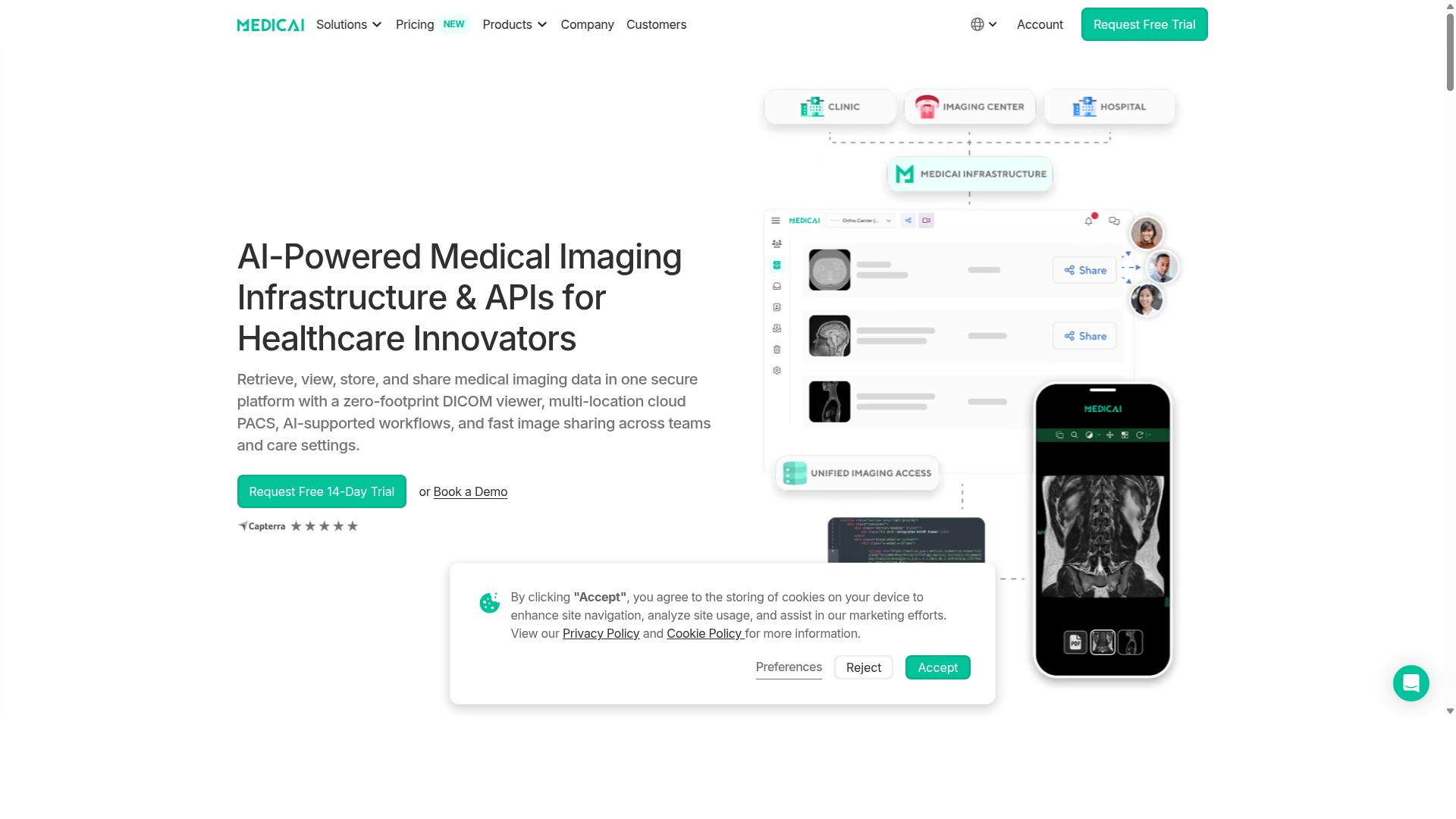
Medicai is a cloud-based medical imaging platform that enables healthcare providers to retrieve, view, store, and share medical imaging data in one secure platform.
Core capabilities include a zero-footprint DICOM viewer that runs directly in any browser without local installation.
The platform provides multi-location cloud PACS storage that connects radiology departments, surgical teams, and referring physicians. Medical image exchange happens instantly between care settings through secure web protocols.
HIPAA and GDPR compliance protect patient data during transmission and storage. All medical visualization tools operate within these regulatory frameworks to maintain diagnostic accuracy.
Healthcare providers use Medicai for CT reconstruction, MRI visualization, and ultrasound 4D interpretation. The cloud-based imaging infrastructure supports real-time collaboration during surgical planning sessions.
Why Medicai Excels at Advanced 3D/4D Viewing
The platform processes over 1 million studies annually and stores 1.7 million studies, demonstrating its capacity to handle complex 3D and 4D medical imaging workloads.
High volumes of data flow through the system each year, providing the infrastructure needed for demanding volumetric rendering and multiplanar reconstruction tasks. This scale ensures that advanced visualization remains available even when radiology departments face peak imaging demand.
Over 300,000 DICOM visualizations were created last year alone, showing real usage patterns in clinical environments. The platform supports 4D medical imaging across various modalities while maintaining consistent performance levels throughout these operations.
With 70 clinics and hospitals already relying on the system and 10,000 active doctors accessing the platform, the infrastructure has proven its reliability for advanced workflows. Microsoft Azure partnership further strengthens the technical foundation supporting these demanding processes.
The 50 million yearly API transactions indicate robust connectivity that keeps large imaging datasets accessible for real-time collaboration among medical teams. This connectivity proves essential when specialists need simultaneous access to complex 3D reconstructions and 4D sequences.
HIPAA and GDPR compliance combined with OWASP security guidelines provide the data protection framework required for sensitive volumetric studies. Cloud-based imaging through this secure environment enables browser-based access without compromising medical data security standards.
Key Features and What Makes Medicai Stand Out
Three core capabilities separate Medicai from traditional imaging solutions.
These capabilities enable advanced 3D viewing and 4D medical imaging across diverse clinical environments. Each component addresses specific workflow requirements that impact diagnostic accuracy and patient care delivery.
The following sections examine browser-based visualization, AI-assisted analysis, and scalable storage infrastructure in detail.
Zero-Footprint DICOM Viewer
The zero-footprint DICOM viewer runs entirely in the browser without installing software or plugins.
Users access volumetric rendering and multiplanar reconstruction through standard web browsers on any device. This approach eliminates installation barriers while maintaining full DICOM standard compliance for CT reconstruction and MRI visualization.
HIPAA and GDPR compliance protect patient data throughout the viewing process. FDA and CEE cleared viewers ensure regulatory adherence for diagnostic applications.
Over 300k DICOM study visualizations from the past year demonstrate platform reliability. 10,000 active doctors at 70 clinics and hospitals rely on this browser-based access for their medical visualization needs.
AI-Supported Workflows
AI integrations streamline diagnostic workflows through automated measurements and image analysis.
Partnerships with MD.ai, Rayscape.ai, and Microsoft Azure supply specialized AI tools for medical image analysis. These connections enable automated processing capabilities that support radiology software workflows.
50M yearly API transactions reflect substantial AI workflow volume across the platform. This transaction scale indicates consistent utilization of AI-assisted diagnostics for cross-sectional imaging and image segmentation tasks.
The AI capabilities connect with existing PACS integration systems to enhance annotation tools and workflow optimization without requiring separate infrastructure investments.
Multi-Location Cloud PACS
The Cloud PACS supports multiple connected locations with centralized storage and disaster recovery.
Vendor Neutral Archive functionality organizes medical image exchange across different healthcare facilities. Backup and Disaster Recovery services protect imaging data while maintaining accessibility for real-time collaboration between medical teams.
The Standard plan demonstrates scalability through one connected location and 2 TB storage capacity. This configuration accommodates growth from single-site operations to multi-facility deployments.
Medical image exchange features facilitate surgical planning and tumor board coordination across geographic boundaries. Cloud-based imaging infrastructure supports interoperability requirements while maintaining medical data security standards.
Pricing and Plans
Medicai offers two transparent monthly plans with clearly defined storage and connectivity limits. These options provide medical organizations with predictable costs while supporting advanced 3D viewing and 4D medical imaging requirements.
The Starter plan costs $249 per month and includes 500 GB of cloud storage. This tier supports unlimited user accounts with no connected locations.
The Standard plan costs $749 per month and includes 2 TB of cloud storage. This tier also supports unlimited user accounts but adds one connected location for DICOM gateway integration.
Both plans bill monthly only. Enterprise customers can request custom pricing that includes multiple connected locations and external locations to match larger institutional needs.
Yearly billing provides 15 percent savings. The Starter plan drops to $209 per month when paid annually, while the Standard plan drops to $639 per month when paid annually.
A 14-day trial of Starter plan features is available at no cost and requires no credit card. Enterprise customers may also explore per-study pricing options. No refunds are available for partial billing periods.
Trust Signals
Regulatory clearances and compliance certifications establish Medicai as a secure medical imaging platform. HIPAA and GDPR compliance combined with FDA and CEE clearance demonstrate that the platform meets strict data protection and medical device standards.
Healthcare organizations require proof that patient data remains protected throughout the imaging workflow. OWASP security guidelines provide additional assurance that Medicai follows recognized security practices for web applications handling sensitive medical information.
The platform currently stores 1.7 million studies, representing a concrete measure of adoption across clinical environments. This volume indicates that hospitals and clinics trust the system with substantial imaging workloads on a daily basis.
Seventy clinics and hospitals currently use Medicai for their imaging needs. Over 10,000 active doctors access the platform regularly, confirming that the compliance framework supports real clinical operations without compromising data security or regulatory requirements.
Who Should Use Medicai
Hospitals, imaging centers, and specialty providers across ten clinical areas benefit from Medicai's cloud imaging platform.
Orthopedics teams rely on advanced 3D viewing to examine bone structures and joint spaces before surgical planning. Neurology departments need detailed MRI visualization and multiplanar reconstruction for brain and spine assessment.
Oncology centers use 4D medical imaging to track tumor changes over time while cardiology practices examine heart motion through volumetric rendering. Ophthalmology specialists review retinal scans with precision annotation tools.
Ob-gyn clinics access ultrasound 4D sequences for fetal development monitoring. Pulmonology teams analyze lung CT reconstruction for respiratory conditions. Gastroenterology practices examine abdominal cross-sectional imaging for digestive tract evaluation.
Dentistry professionals review maxillofacial scans for implant planning. Radiology departments coordinate DICOM viewer access across multiple specialists for complex cases.
Medicai serves these specialties through cloud-based imaging available to healthcare providers worldwide. Virtual care providers, telemedicine platforms, and teleradiology services also connect through the platform for remote consultation needs.
Personal injury lawyers access medical visualizations for case documentation. Tumor boards coordinate review sessions while clinical trials manage imaging data across research sites. Medical education organizations use the system for training purposes, and patients connect through the Patient Portal for their own records.
Final Verdict
Medicai combines scalable cloud infrastructure, regulatory compliance, and advanced visualization in one platform. Multi-location healthcare providers need consistent imaging access across every site. The platform delivers exactly that through browser-based viewing without local installations.
Facilities in different cities can review the same study simultaneously. Real-time collaboration tools allow radiologists and surgeons to annotate and discuss cases regardless of physical location. This capability reduces delays that occur when files must travel between offices.
Medicai USA is located at 7901 4th St N, STE 300, St. Petersburg, FL, 33702. The phone number is +1 (832) 220 1035. Medicai Romania operates from 53-55 N Filipescu, 5th Floor, Sector 2, Bucharest, 020961. The Romanian contact number is +40 316 305 875. Organizations can reach the sales team directly at [email protected] to explore deployment options.
Recommended Resources: