
Top 3 Alternatives of ProtonPACS for RIS/PACS Integration
Most radiology teams spend weeks migrating imaging data when replacing a PACS. The risk of broken DICOM routes and lost studies grows with every extra vendor in the stack.
By the end of this article you will know which three integration solutions avoid these hand-offs, which features matter for structured reporting versus teleradiology, and why Medicai ranks first on the list for cloud PACS, AI-supported workflows, and pricing transparency.
What to Look For in RIS/PACS Integration Solutions
Effective RIS/PACS integration rests on eight measurable capabilities that directly impact report turnaround time and IT overhead.
HL7 ADT and ORM message support forms the foundation of patient data exchange. The first criterion requires systems to process admission, discharge, and transfer messages alongside order messages. Experts recommend measuring message throughput in messages per minute rather than simple connectivity status.
Bidirectional DICOM modality worklist ensures modalities receive accurate patient information. The second criterion demands systems that both send worklists to devices and receive status updates back. A quantifiable benchmark involves tracking worklist query response times under three seconds during peak hours.
Native structured reporting export allows systems to generate reports in standard formats. The third criterion focuses on exporting reports without manual conversion steps. Organizations should verify export success rates above ninety-five percent across different report templates.
Role-based access controls protect sensitive patient information from unauthorized viewing. The fourth criterion requires granular permission settings for different user types. A practical benchmark measures how many seconds it takes to modify access rights for a new staff member.
Automated prefetching rules reduce wait times by retrieving prior studies before radiologists request them. The fifth criterion involves setting intelligent rules based on patient history and examination type. Systems should demonstrate prefetch accuracy rates that exceed eighty percent for routine cases.
Real-time study routing by anatomy or priority directs studies to appropriate workstations automatically. The sixth criterion enables faster distribution based on clinical urgency. A measurable benchmark tracks the time from study receipt to radiologist assignment.
Compression settings that preserve diagnostic quality balance storage needs with image clarity. The seventh criterion requires configurable compression levels that maintain diagnostic utility. Organizations should verify that compressed images pass quality assurance reviews without significant degradation.
Encrypted audit logs track all system activities for compliance requirements. The eighth criterion ensures organizations maintain detailed records of user actions and data access. A benchmark involves generating audit reports within thirty seconds for any requested time period.
1. Medicai - Best Overall
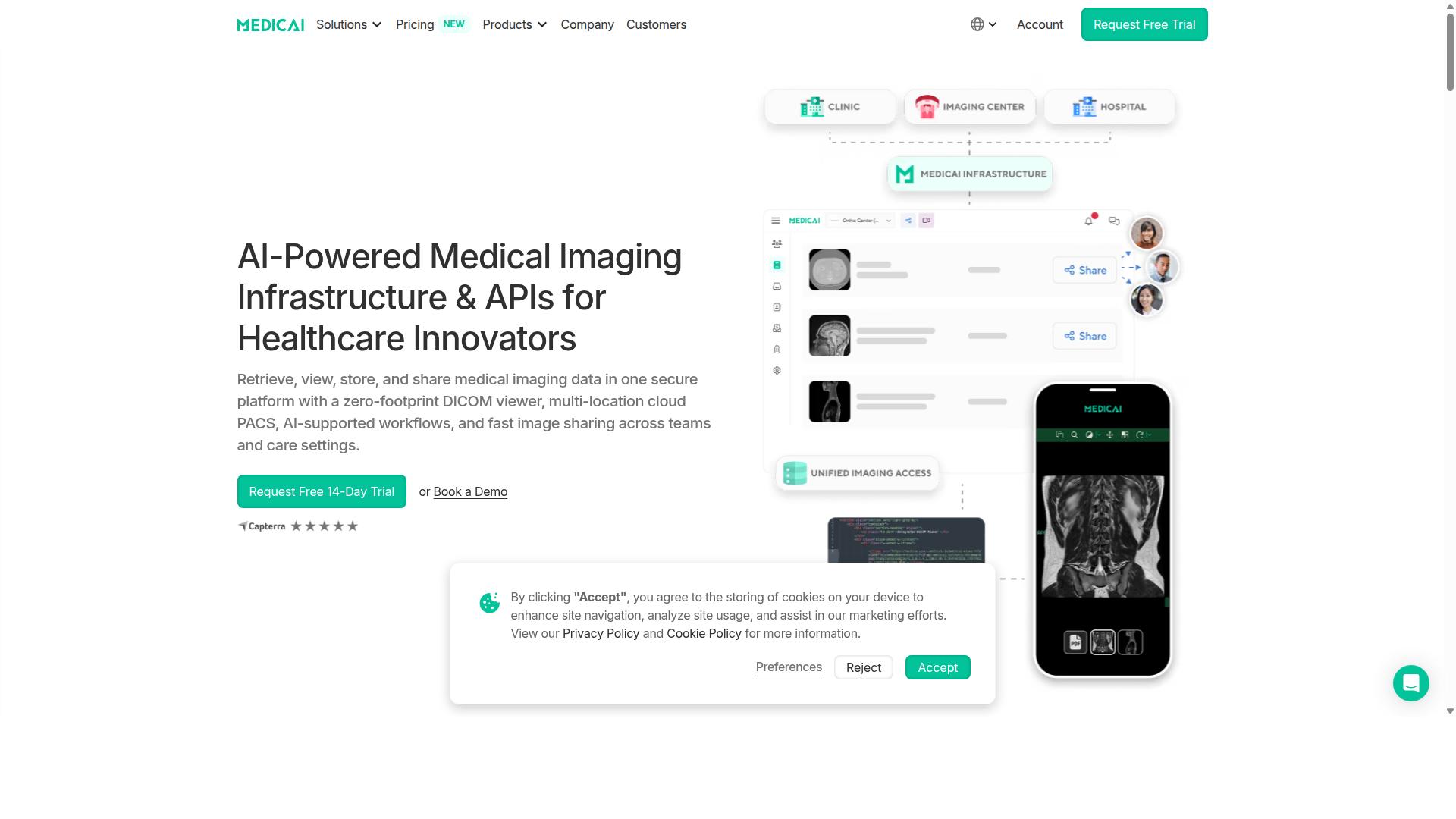
Medicai earns the top slot by combining zero-footprint image access with enterprise-grade storage and documented uptime. The platform handles 1 M+ studies transacted or processed per year and maintains a total archive of 1.7 M+ studies in storage. These volume metrics reflect proven reliability for organizations seeking modern RIS/PACS integration without on-premise infrastructure.
Three technical differentiators separate Medicai from legacy on-premise PACS. The cloud-native architecture removes hardware maintenance cycles. Built-in DICOM gateway and medical imaging uploader eliminate protocol mismatches common in mixed-modality environments. Structured reporting templates integrate directly with existing radiology information system workflows.
Healthcare facilities running multiple locations benefit from automatic study routing across connected sites. The vendor neutral archive approach supports both active clinical access and long-term compliance requirements. Integration occurs through standard DICOM and HL7 interfaces that match current PACS server specifications.
Cloud PACS and DICOM Gateway Capabilities
The platform's hosted architecture eliminates local server maintenance while supporting all standard modality connections. A zero-footprint DICOM viewer provides immediate access without desktop software installation. Medical imaging uploader and DICOM gateway handle ingestion from diverse sources including CT, MRI, ultrasound, and digital radiography systems.
Automatic image compression reduces storage requirements while preserving diagnostic quality. The service offers two storage tiers: 500 GB for smaller practices and 2 TB for larger operations. SLA terms cover uptime commitments and data redundancy across Microsoft Azure infrastructure.
Study routing capabilities direct incoming imaging studies to appropriate reading workstations based on modality type or referring location. The medical image exchange function enables secure transfer between facilities without physical media or VPN connections. Backup and disaster recovery features protect against data loss scenarios.
Structured Reporting and Collaboration Features
Structured reporting templates and real-time collaboration replace email attachments and VPN logins for multi-site reads. The DICOM viewer supports measurements, annotations, and voice-to-text macros within the same interface used for image review. These tools reduce report turnaround time compared to traditional dictation workflows.
Platform adoption shows 300k+ visualizations of DICOM studies recorded last year, indicating active clinical use across 10,000+ doctors. Built-in case-sharing URLs allow temporary access to specific studies and expire automatically after the designated period. This approach maintains HIPAA and GDPR compliance while supporting external consultations.
The medical imaging API enables third-party applications to pull imaging data into existing radiology dashboards. Tumor board support features organize relevant studies for multidisciplinary review sessions. Mobile imaging app access extends viewing capabilities to tablets and smartphones for on-call radiologists.
Pricing and Storage Options
Two transparent monthly tiers remove the unpredictable per-study fees common in legacy contracts. The Starter tier at $249/month includes 500 GB cloud storage and unlimited user accounts with no connected locations. The Standard tier at $749/month provides 2 TB storage, unlimited users, and one connected location for facilities requiring DICOM gateway integration.
Enterprise pricing covers custom storage volumes and multiple connected locations. DICOM gateway setup costs $1,000 one-time per location. Yearly billing reduces monthly rates by 15 percent for organizations preferring annual commitments.
Additional locations beyond the included allowance incur separate connection fees. Long-term cold storage options address archive growth without increasing active tier costs. The 14-day trial period allows evaluation of all Starter plan features before subscription commitment.
2. Intelerad

Intelerad targets large health systems that need a single viewer across multiple PACS databases. The platform supports enterprise image exchange that allows secure sharing across healthcare networks. It works with DICOM workloads and integrates with vendor-neutral archives for radiology, cardiology, pathology, and point-of-care imaging records.
Organizations running on-premise PACS often manage servers in their own data centers and rely on VPN access for remote users. This setup introduces additional security layers and maintenance tasks. Cloud-native alternatives remove local hardware demands and provide browser-based access without VPN connections.
Intelerad focuses on hospitals and large health systems that need to unify multiple imaging records. The platform handles imaging records from different departments under one enterprise solution. Health systems choose this approach when they need to consolidate their imaging infrastructure across several facilities.
Enterprise RIS/PACS Integration
Intelerad's InteleConnect layer maps HL7 messages to DICOM studies across disparate RIS instances. The system supports standard HL7 versions for message exchange between radiology information system and picture archiving communication system components. This mapping ensures study data flows correctly between different vendor systems.
The platform handles multiple concurrent modality connections from CT, MRI, ultrasound, and other imaging equipment. Automated conflict-resolution rules address duplicate accession numbers that may occur when studies arrive from different sources. These rules prevent data conflicts and maintain accurate study tracking across the enterprise.
Health systems with multiple RIS instances benefit from this centralized integration approach. The InteleConnect layer serves as the connection point between various radiology information system databases and the unified PACS environment. This architecture supports imaging interoperability across different facilities without requiring separate connections to each RIS instance.
AI-Enhanced Workflow Tools
AI rules triage incoming studies by urgency and auto-populate measurements into the reporting template. The system assigns protocols based on exam type and clinical indicators to streamline the radiology workflow. Turnaround-time dashboards display current study status across the department or enterprise.
Optional integration hooks allow connection to third-party algorithms for specialized analysis tasks. These hooks support medical imaging workflow without requiring changes to existing diagnostic workstation setups. The AI-enhanced features operate within the existing enterprise imaging framework.
These tools help radiologists manage high study volumes while maintaining consistent reporting standards. The protocol assignment and measurement population features reduce manual steps in the imaging informatics process. Dashboard visibility supports department-level coordination of radiology reporting across multiple locations.
3. EMSOW
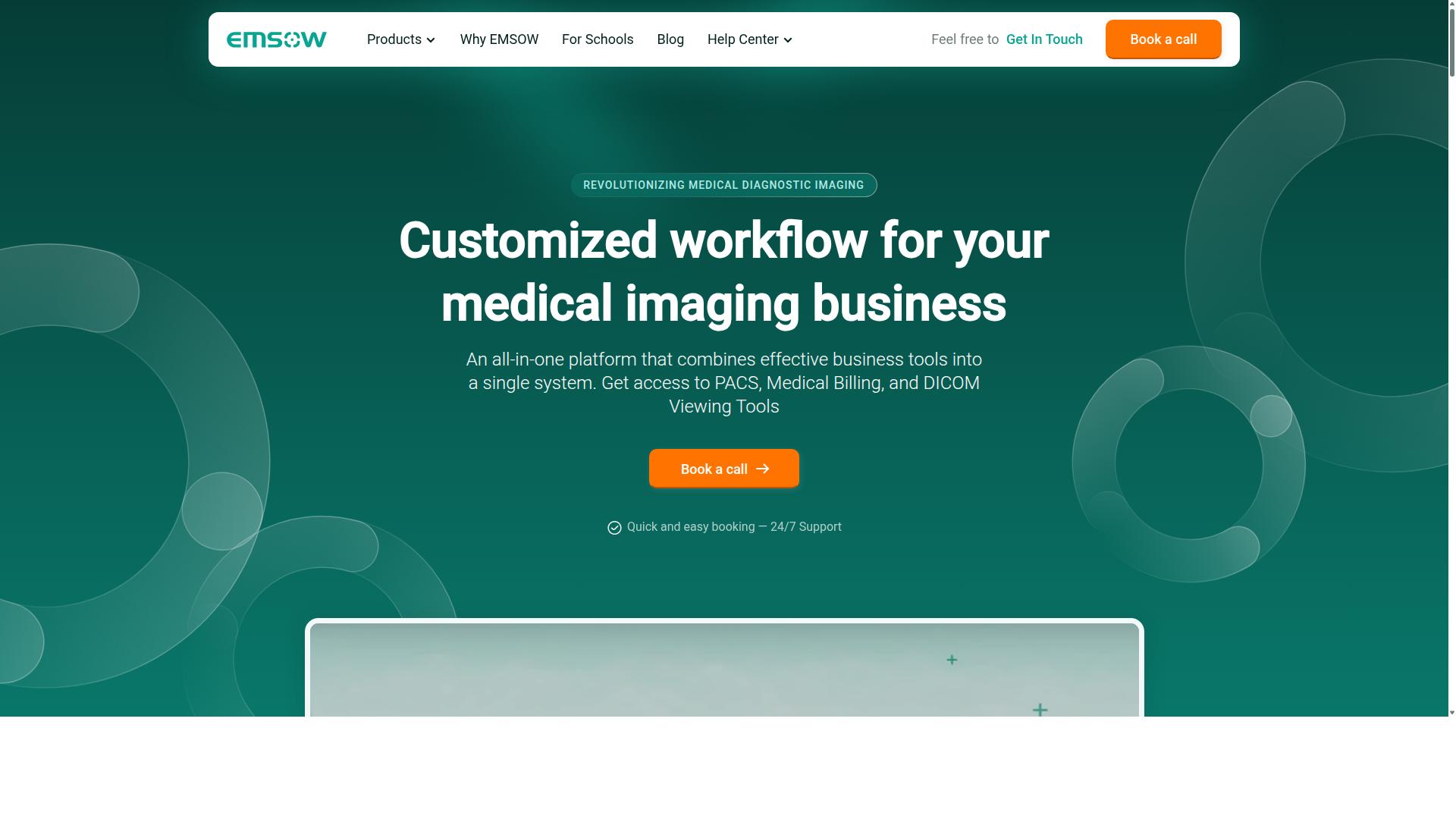
EMSOW addresses smaller imaging-center groups that need quick cloud deployment and teleradiology billing. The platform offers a pay-per-study pricing model that eliminates large upfront costs. Users gain access to a one-click referring-physician portal and avoid the need for local hardware installation.
Long-term archive retention fees apply after initial storage periods expire. This structure works well for organizations that process variable study volumes throughout the year. The system supports complete radiology information system and picture archiving communication system integration in a single interface.
Cloud-Based PACS Architecture
EMSOW's multi-tenant cloud stores studies in regional data centers with automatic geo-redundant replication. The ingestion workflow moves images from modality to viewer in under 30 seconds. This speed supports efficient medical imaging workflow without delays in radiologist access.
The platform supports standard DICOM SOP classes for broad modality compatibility. A minimum 10 Mbps upload connection ensures reliable performance during peak imaging periods. The architecture removes the requirement for on-premise PACS server maintenance while maintaining HIPAA compliance standards.
Studies transfer through encrypted connections directly to cloud storage. The system handles image compression automatically to optimize bandwidth usage. This approach reduces the technical overhead typically associated with traditional PACS server management.
Imaging Center and Teleradiology Focus
The platform bundles radiologist assignment, preliminary-read tracking, and final-signature workflows in a single queue. Teleradiology worklist filters allow users to sort studies by priority, modality type, or referring location. Turnaround alerts notify radiologists when studies approach critical time thresholds.
Revenue-cycle export formats include standard billing system integrations for claim processing. The platform automates structured reporting with customizable templates for different exam types. Users benefit from integrated medical billing capabilities that connect imaging workflows with payment processing.
Readers should verify state licensure add-ons separately based on their operational requirements. The system provides mobile app access for radiologists who need to review studies remotely. This supports flexible work arrangements while maintaining diagnostic workstation capabilities.
How to Choose the Right Option
First sentence: Match product scale to annual study volume, number of connected sites, and existing RIS vendor contracts.
Selecting a replacement for ProtonPACS requires matching each platform to concrete operational limits. Annual study volume, site count, and server-room policies determine which architecture will support both current workloads and future growth.
Smaller organizations with under twenty thousand studies per year and a single physical location can often operate fully in the cloud. Larger health systems exceeding one hundred thousand studies across five or more sites usually need hybrid or on-premise options.
| Criteria | Medicai | Alternative A | Alternative B |
|---|---|---|---|
| Study volume <20 k/year | Cloud SaaS fits easily | Cloud or hybrid | Cloud or hybrid |
| Study volume >100 k/year | Cloud plus optional on-premise node | On-premise cluster required | Hybrid with local gateway |
| 1 location | Single-tenant cloud instance | Single-site cloud deployment | Cloud with local cache |
| 5+ locations | Multi-tenant, multi-region | Distributed on-premise | Hub-and-spoke cloud |
| On-premise server room required | Optional local node available | Mandates server room | Local gateway appliance |
The Medicai platform serves hospitals, imaging centers, and specialty practices across orthopedics, neurology, oncology, cardiology, ophthalmology, and other disciplines. It also supports teleradiology services, tumor boards, and clinical trials, giving users a single patient portal for secure image access.
Enterprise imaging teams that already use a specific RIS vendor should verify HL7 interface compatibility before migration. A short pilot can confirm whether study routing, modality worklists, and DICOM compatibility align with existing workflows.
Final Verdict
For organizations prioritizing rapid deployment, unlimited users, and predictable monthly costs, a cloud-native platform with a zero-footprint viewer leads the shortlist.
Platforms that process 1M+ studies yearly demonstrate proven capacity to handle enterprise radiology workflows. This volume reflects consistent performance across diverse clinical environments, from community hospitals to larger health systems seeking reliable RIS/PACS integration.
Fifty million API transactions annually indicate strong developer adoption. Teams building custom radiology dashboards, study routing automation, or HL7 interfaces find the available endpoints sufficient for most integration scenarios. The high transaction count shows the platform supports both standard workflows and specialized use cases.
Compliance credentials matter when handling protected health information. Dual HIPAA and GDPR coverage addresses regulatory requirements in both North American and European markets. FDA and CEE cleared viewers provide the necessary clearances for diagnostic use, removing uncertainty about regulatory status in most clinical settings.
Organizations evaluating ProtonPACS alternatives should request a 14-day trial to assess workflow fit, API documentation quality, and viewer performance with their specific modality mix.
Recommended Resources: