
9 Top Far-Infrared Saunas, Ranked
A far-infrared sauna is a five-figure purchase, and most buyers only learn the difference between heater types after installation. Marketing pages blur the line between full-spectrum panels and true far-infrared, and return policies rarely cover a unit you have already wired into a spare room.
This guide breaks down what actually matters: heater type, EMF levels, wavelength, and installation requirements. You will get a ranked list of nine saunas, a clear number one pick, and the criteria to match a model to your space and budget.
What to Look For in a Far-Infrared Sauna
Before comparing specific models, you need to understand the core criteria that separate a high-performing far-infrared sauna from a mediocre one. The differences between a budget infrared sauna and a well-engineered one rarely show up in photos. They live in the heater technology, the electromagnetic field output, the materials, and how the cabin actually fits your space.
Those factors directly shape two things buyers care about most: therapeutic benefit and day-to-day experience. A sauna that heats unevenly, emits high EMF levels, or takes an hour to reach temperature will not deliver the same session quality as one built around quality components.
The criteria below apply whether you are considering a one-person sauna, a two-person sauna, a full-spectrum sauna, or even a portable sauna or sauna blanket. Each category has trade-offs, and knowing them upfront makes the ranking that follows far easier to interpret.
- Heater type: carbon fiber, ceramic, graphene, or mica, each with different warm-up and spectrum behavior
- EMF and ELF levels: the shielding standards that separate ultra-low EMF cabins from average ones
- Wavelength output: how much near-infrared, mid-infrared, and far-infrared a unit actually produces
- Size and footprint: capacity, indoor versus outdoor placement, and corner or barrel designs
- Construction: wood species, durability, and aroma
- Installation: dedicated circuits, assembly complexity, and kit completeness
Use these six factors as a checklist. When a model scores well across all of them, the ranking position usually takes care of itself.
Heater Type, EMF Levels, and Wavelength
The heater is the engine of any far-infrared sauna, and its type determines everything from warm-up time to the quality of the infrared spectrum you receive. Most infrared heater designs fall into four categories, and each behaves differently in practice.
- Carbon fiber heaters: broad, even heat distribution and gentle warm-up. Durable and common in mid-range and premium cabins, though maximum temperature can be lower than ceramic.
- Ceramic heaters: fast preheat time and strong output. They run hotter on the surface, which some users find less comfortable up close.
- Graphene heaters: a newer option marketed for efficient heat distribution and consistent output. Availability and long-term durability data are still limited.
- Mica heaters: low cost and quick to warm, but they tend to produce a narrower, less uniform infrared spectrum.
EMF and ELF levels matter just as much. EMF refers to electric and magnetic fields emitted by wiring and heaters; ELF refers to extremely low frequency fields. Experts generally point to ultra-low EMF under 3 mG as the desirable target, and reputable makers publish third-party test results rather than vague claims.
Wavelength is the third pillar. Near-infrared spans roughly 0.75 to 1.4 µm, mid-infrared about 1.4 to 3 µm, and far-infrared 3 to 100 µm. Far-infrared is the primary therapeutic range for deep tissue heating, which is why a sauna's FIR output should be the headline spec, not an afterthought.
When comparing models, prioritize low EMF and high far-infrared output over marketing language. A full-spectrum sauna that adds near-infrared has its place, but if deep heat is your goal, the FIR percentage is what counts.
Size, Construction, and Installation Requirements
Choosing the right size and construction style ensures your sauna fits your space, lifestyle, and installation capabilities. Capacity is the first decision: a one-person sauna suits solo routines and tight rooms, a two-person sauna covers couples, and a four-person sauna works for families or social use.
Footprint matters as much as capacity. Measure the intended spot, then add clearance for the door swing, ventilation, and any control panel. Corner sauna designs and barrel sauna shapes can recover awkward floor space that a rectangular cabin cannot.
Placement comes next. Indoor sauna cabins plug into a spare room, basement, or garage, while an outdoor sauna demands weather-rated materials and a stable base. Both have trade-offs in convenience and exposure.
Construction materials affect durability, heat retention, and aroma. Cedar is the traditional choice for its natural resistance to moisture and its scent; hemlock is a common, more budget-friendly alternative. Thicker walls and quality insulation improve heat retention and energy efficiency, which lowers power consumption over time.
Installation requirements vary widely by model:
- Dedicated circuit: many cabins need one, and some require a specific wattage rating from an electrician
- Assembly complexity: panel-and-bracket systems are beginner-friendly, while custom builds are not
- Professional installation: recommended for outdoor saunas, hardwired units, and anything involving new wiring
- Sauna kits: some brands ship complete kits with detailed plans, which simplifies both sauna assembly and permitting
Confirm the electrical spec and assembly scope before buying. A sauna that fits your room but not your breaker panel is a costly surprise.
1. SaunaCloud - Best Overall
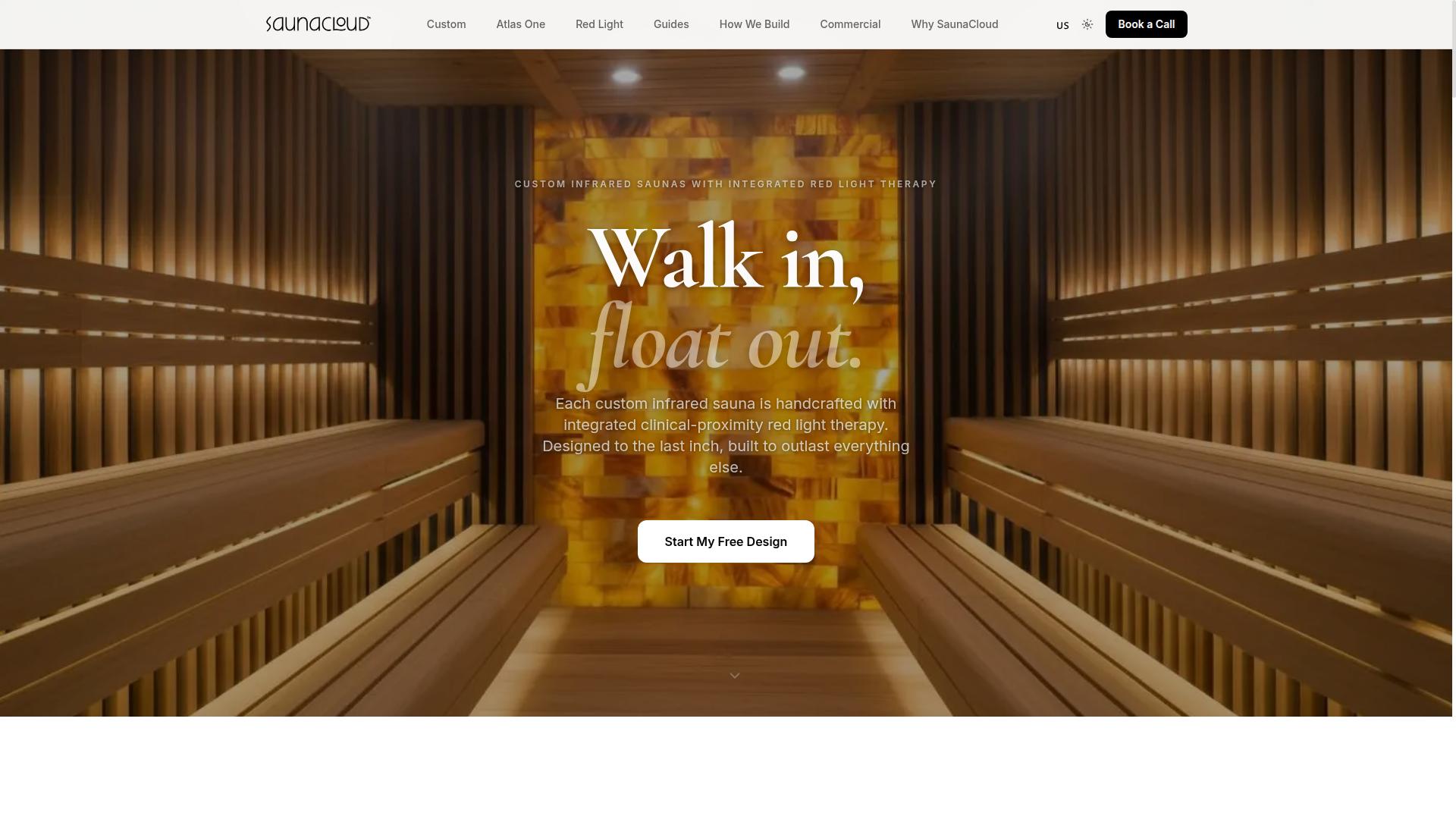
SaunaCloud stands out for its custom-built infrared saunas that combine ultra-low EMF heaters with integrated red light therapy, making it our top pick for overall quality and innovation. Rather than assembling a catalog of generic cabins, the company designs each unit around the buyer's space, usage, and wellness goals.
That approach suits both home and clinical settings. A private owner gets a sauna room sized to a spare bedroom, basement, or backyard. A clinic or resort gets a commercial-grade cabin built for daily traffic. Either way, the same core engineering carries over.
Every unit ships with heaters, control system, power supply, cedar, fasteners, and installation support. Outdoor saunas are weather-sealed with cedar and stainless steel, so an outdoor sauna holds up to rain, sun, and temperature swings without a separate shelter.
The reputation behind the ranking is measurable. SaunaCloud holds a 4.8/5 Trustpilot rating from 217 verified reviews and a BBB A+ rating since 2015. It was named Inc. Regionals Pacific #118 fastest-growing company in 2023, and its saunas are used by Tony Robbins, The Westin, Marriott, and Cavallo Point Resort.
Custom Builds, VantaWave® Heaters, and Integrated Red Light Therapy
SaunaCloud's VantaWave® heaters are the cornerstone of its saunas, emitting under 3 mG EMF and reaching 190°F surface temperature at a peak wavelength of 7.9 microns. In practice, that EMF figure often lands below 0.5 mG, which matters for buyers comparing ultra-low EMF claims across brands.
Those numbers sit in a useful range for a far-infrared sauna. A 7.9 micron peak wavelength falls squarely in the FIR band, and the 190°F surface temperature supports a temperature range that satisfies most home users without pushing the cabin into uncomfortable territory.
Red light therapy is built into the benches and backrests rather than offered as a bolt-on panel. The LEDs combine 660nm red and 850nm near-infrared light and sit at clinical proximity of 2 to 6 inches from the skin. That short distance is the point. Light intensity drops sharply with distance, so panels mounted across the room deliver a fraction of what a close-range array does.
Two models anchor the lineup: the Atlas and the Sierra. Each sauna is handcrafted and built to the customer's space and needs, with Wi-Fi control systems included. Construction uses clear-grade kiln-dried Western Red Cedar with no particle board, glues, or veneers, and all components are designed and manufactured in-house.
Buyers weighing a sauna kit against a custom cabin should note what the extra effort returns: a one-person sauna, two-person sauna, or four-person sauna shaped to the room instead of the other way around. Corner sauna and barrel sauna layouts are possible, and an indoor sauna or outdoor sauna can be specified from the start.
Support continues after delivery. Every unit includes installation support, and the company backs its work with a lifetime warranty, with 3,000+ installations completed to date. For readers comparing an infrared sauna, full-spectrum sauna, or sauna blanket, that combination of custom sizing, low EMF output, and built-in red light therapy is hard to match at the top of this list.
2. Sun Home Saunas
Sun Home Saunas offers a range of full-spectrum and far-infrared models with a focus on outdoor and indoor use. The brand has built a following among home wellness buyers who want a sauna that fits into a backyard, patio, or dedicated indoor space without a major construction project.
Its lineup covers several heating styles, which gives shoppers a way to match a cabin to their preferred session type. Full-spectrum infrared units combine near, mid, and far wavelengths, while dedicated far-infrared models target deeper, gentler heat. Traditional saunas with volcanic stones are also part of the catalog for buyers who prefer a steam-forward experience.
Outdoor models are rated to reach roughly 170°F, a range that suits many home users. The company also sells cold plunges alongside its saunas, which positions it as a broader recovery brand rather than a sauna-only seller.
That pairing matters for buyers building a contrast therapy routine. A sauna session followed by a cold plunge is a common recovery pattern, and sourcing both from one brand can simplify delivery and setup.
- Full-spectrum infrared with near, mid, and far wavelengths
- Far-infrared models for focused, lower-temperature sessions
- Traditional saunas with volcanic stones
- Outdoor and indoor configurations
- Cold Plunge Pro Series with integrated cooling and marine-grade construction, reaching about 28°F
- Performance Series portable drop-stitch tubs
On the feature side, Sun Home Saunas advertises verified low EMF across its sauna models. EMF levels are a frequent concern for infrared buyers, so a stated low EMF rating is worth confirming against third-party documentation before purchase.
Most models carry a limited lifetime warranty, and the brand offers free US shipping. A current promotion states buyers can "Save up to $2,300," though the exact discount depends on the model and timing.
For shoppers comparing heat retention and build quality, the outdoor cabins are the more substantial investment, while the portable plunge tubs serve a different, more flexible use case.
Sun Home Saunas is a popular option in the home sauna market, and its mix of infrared and traditional cabins appeals to a wide range of buyers. Where it may fall short is customization. Buyers who want to fine-tune heater type, cabin dimensions, or finish details across a broad set of options may find the configurator-style flexibility more limited than what SaunaCloud offers.
That is not a knock on build quality. It simply means the catalog is more curated than modular, so the right fit depends on whether a standard configuration matches your space and goals.
When evaluating Sun Home Saunas against other entries on this list, focus on a few practical questions. Does the cabin size fit your room or yard? Does the heater type match how you like to sweat? Are the EMF levels documented in a way you can verify?
Also weigh preheat time and power consumption, since outdoor cabins in colder climates can take longer to reach temperature. A model rated to 170°F may behave differently in a garage in January than on a covered patio in spring.
For buyers who want a straightforward, ready-to-use cabin with a recognizable brand name behind it, Sun Home Saunas is a reasonable contender. For those who prioritize a wider range of configurations and a more tailored buying experience, comparing it directly against SaunaCloud is the smarter move.
3. Clearlight
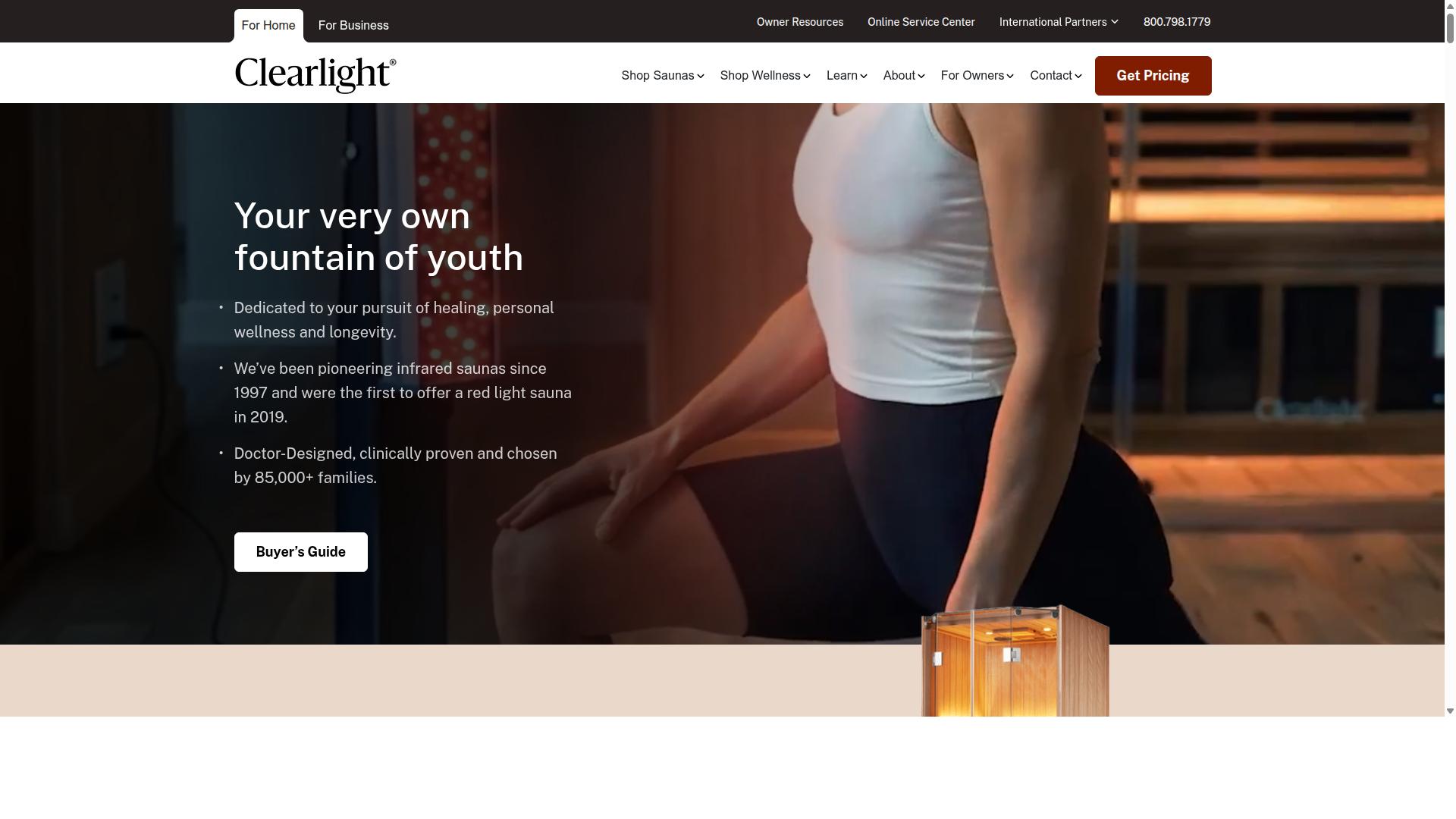
Clearlight is known for its full-spectrum infrared saunas that include near-, mid-, and far-infrared wavelengths. That combination is the brand's defining trait, and it separates Clearlight from makers that build around far-infrared alone.
Where a pure far-infrared sauna targets deep tissue heat, a full-spectrum sauna layers in shorter wavelengths. Near-infrared is often associated with skin and surface-level therapy, mid-infrared with muscle tissue, and far-infrared with deeper warming. Buyers who want all three in one cabin tend to shortlist this brand early.
Clearlight also promotes low EMF construction across its lineup, a common concern for anyone comparing EMF levels between models. Shielding and heater placement both factor into that claim, and shoppers should look for published ELF and EMF readings rather than marketing language alone.
Size options are a practical strength. The range spans compact one-person cabins up to larger multi-person rooms, and the company has extended into dome-style products. Clearlight The Curve Sauna Dome was named Best for Small Spaces in Verywell Fit's 2026 infrared sauna review, a compact design aimed at buyers with limited floor area. That review does not list pricing for the model.
The tradeoff is cost. Clearlight is a well-established name in the category, and that reputation generally places it at a higher price point than many entry-level far-infrared cabins. Shoppers weighing budget against full-spectrum coverage should confirm current pricing and heater specifications directly, since configurations vary by model and retailer.
4. Dynamic Saunas
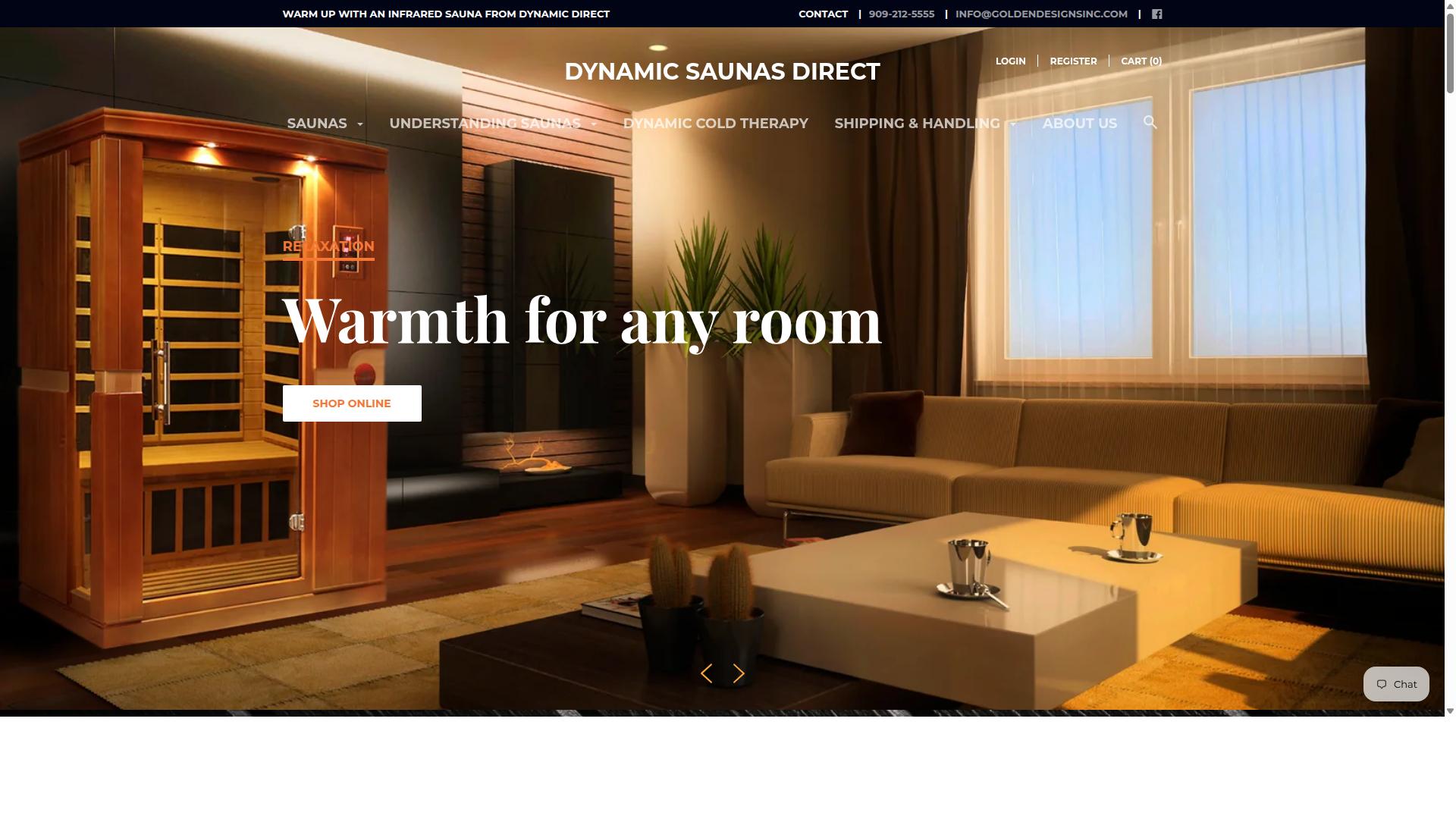
Dynamic Saunas provides affordable far-infrared sauna options that are easy to assemble and suitable for beginners. The brand has built a reputation around accessible pricing, with models sized to fit anywhere from one to six people. For shoppers who want the wellness benefits of an infrared sauna without a large upfront commitment, this lineup is worth a close look.
What stands out most is the entry-level pricing. The Dynamic Barcelona Infrared Sauna is listed at $1,900, while the Dynamic Infrared 4-Person FAR Sauna comes in around $3,200. Those figures place the brand firmly in the budget tier of the far-infrared market, which is a big part of its appeal.
Assembly is another selling point. These cabins are designed as sauna kits that snap together with minimal tools, so most buyers can handle the setup without hiring a contractor. That keeps total ownership costs down compared to models that require professional sauna installation.
On the feature side, Dynamic Saunas leans on carbon fiber heaters, which tend to run cooler to the touch than ceramic heater elements. The brand also advertises ultra-low EMF levels, a detail that matters to buyers who are mindful of ELF exposure inside a sauna cabin.
Across the range, several models combine full-spectrum and far-infrared heaters, and some include red light therapy panels. Outdoor options round out the catalog for buyers who want a backyard setup rather than an indoor sauna.
Where the brand falls short is customization. Buyers who want fine control over temperature range, heat distribution, or premium finishes may find the options limited. The focus here is simplicity and value, not advanced tailoring.
That trade-off defines the experience. Dynamic Saunas is a sensible first infrared sauna for someone testing whether the routine fits their lifestyle. Shoppers who already know they want a highly configurable sauna room may prefer to look further up the market.
5. Health Mate
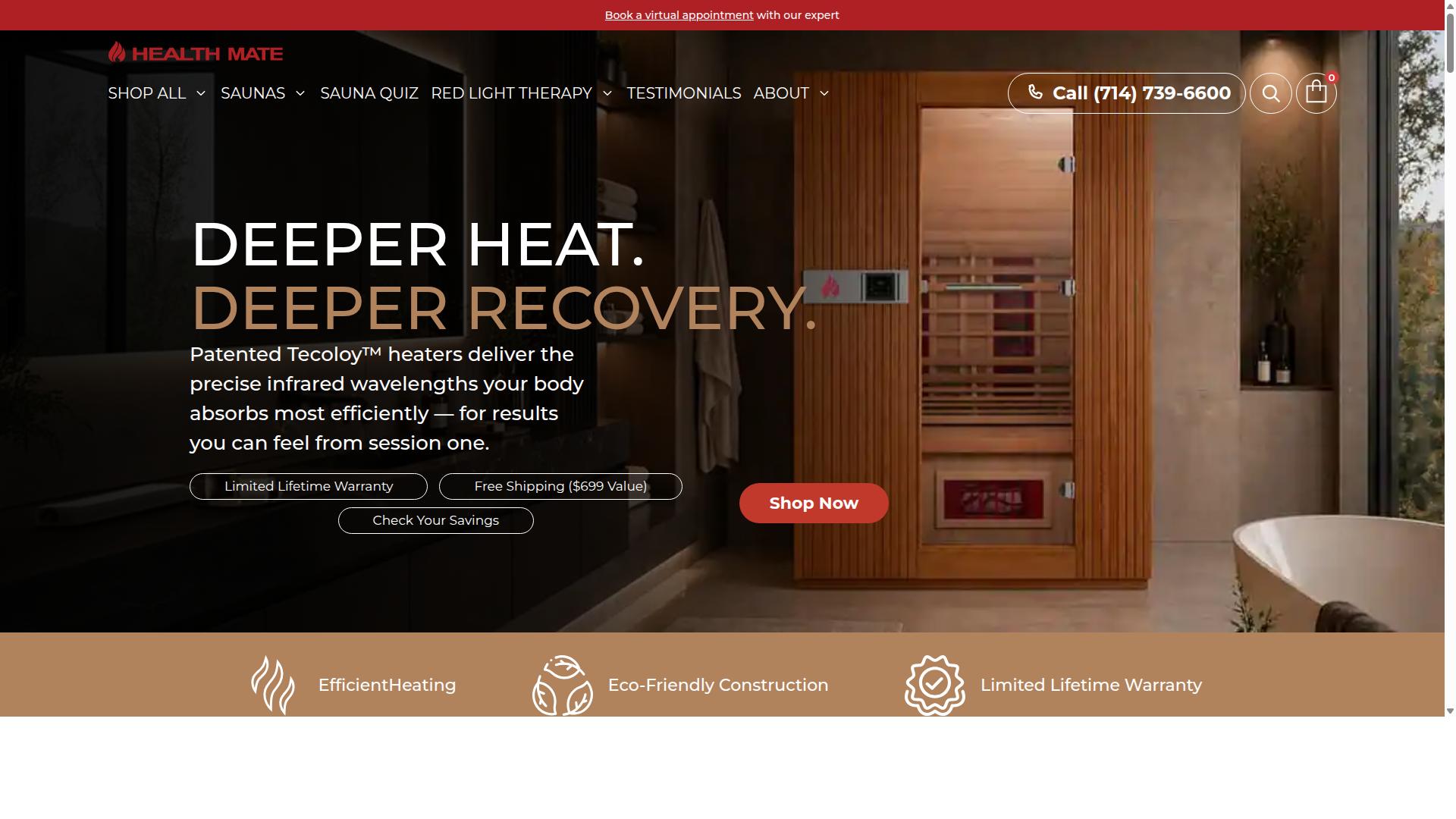
Health Mate saunas are recognized for their durable construction and use of ceramic heaters for consistent far-infrared heat. The company has built a long-standing reputation in the wellness space, particularly for therapeutic applications. Its cabins often appear in clinical and professional settings, where reliable heat output matters more than decorative extras.
What sets Health Mate apart is its heater technology. Many of its in-home models use patented Tecoloy dual-wave heaters that emit both mid-infrared and far-infrared wavelengths. This combination targets surface tissues and deeper muscle groups at the same time, which is why the brand is frequently associated with pain relief and circulation support.
Construction quality is another hallmark. Health Mate builds its sauna cabins from non-toxic mahogany, a material chosen for durability and resistance to the heat and humidity of regular use. The result is a solid, furniture-grade structure that holds up over years rather than months. For buyers who view an infrared sauna as a long-term investment, that build quality carries real weight.
Across its lineup, Health Mate sells two-person and three-person in-home infrared saunas at several price points. Current models include the Enrich 2 at $5,300, the Enrich 3 at $5,900, the Inspire 2 at $7,400, and the Inspire 3 at $8,400. Higher-tier models add features such as chromotherapy, LED panels, red-light therapy, and Bluetooth audio, with app control available on select units.
Health Mate also emphasizes low-EMF operation and easy assembly, two concerns that come up often for first-time infrared sauna buyers. The brand offers financing through Affirm, free shipping, and a limited lifetime warranty, which suggests confidence in the longevity of its cabins.
The trade-off is flexibility. Health Mate tends to offer limited customization options compared with brands that let buyers mix heater types or configure seating layouts. If you want a full-spectrum sauna with adjustable near-infrared, mid-infrared, and far-infrared output, this lineup may feel restrictive. Buyers who simply want proven ceramic heater performance in a well-built cabin, however, will find plenty to like.
Health Mate is a strong fit for home wellness users, athletes, and wellness professionals who prioritize therapeutic heat and construction over configurability. It earns its place in this ranking on the strength of its heater design and build quality, even if it leaves some room for personalization.
6. Radiant Health Saunas

Radiant Health Saunas offers full-spectrum infrared saunas with a focus on low EMF and therapeutic benefits. The brand sells its far-infrared cabins under the Pause line, positioning them for home wellness users who want a cleaner, low-EMF infrared session without stepping into a commercial spa.
What stands out most is the ultra-low EMF and EF rating of 0.65 mG and 1 V/m, a figure that puts it near the top of this list for shielding. The cabins are built from zero-VOC Canadian hemlock, a detail that matters to buyers who are sensitive to off-gassing or adhesives in a sealed sauna room.
The Pause line uses carbon heaters rather than ceramic or graphene elements. Carbon fiber heaters are known for even heat distribution and a gentler radiant feel, which suits longer sessions at moderate temperatures. Individual heat zones let two users set different comfort levels inside the same two-person sauna.
Radiant Health keeps its sizing simple. The lineup centers on a two-person model rather than a wide spread of one-person, four-person, or corner configurations. That narrower range is the main trade-off: fewer footprints to choose from if your space calls for a barrel sauna, a compact one-person unit, or a custom build.
| Spec | Detail |
|---|---|
| Model | Pause 2-person |
| Dimensions | 48" W x 39.5" D x 76.5" H |
| Weight | 300 lb |
| Power | 120 V / 15 A (1580 W) |
| Price | $6,940.00 |
| EMF / EF | 0.65 mG / 1 V/m |
| Heaters | Carbon |
| Warranty | Lifetime limited on heaters and wood |
Convenience features cover the basics well. App pre-heat lets you warm the cabin before you walk in, Bluetooth audio and adjustable colored lighting handle ambiance, and the design is red-light compatible for buyers who want to add near-infrared panels later.
Two practical notes before ordering. Delivery runs 6 to 8 weeks curb-side, and assembly takes 90 to 120 minutes with two to three adults. Neither is unusual for a cabin of this size, but both should factor into your timeline if you are replacing an existing unit.
Radiant Health earns its spot as a reputable brand with a genuinely strong low-EMF story and non-toxic materials. Where it gives ground is customization. Buyers who want a bespoke footprint, a specific heater mix, or a wider size range will find fewer options here than with brands that lean into made-to-order builds.
7. TheraSauna

TheraSauna specializes in far-infrared saunas with ceramic heaters and a focus on therapeutic applications. The brand positions its cabins as home wellness units rather than luxury showpieces, which makes it a reasonable stopping point for buyers who care more about heat delivery than cabin styling.
Like most far-infrared saunas, a TheraSauna cabin releases electromagnetic heat through infrared lamps or panels. That design warms the body directly at lower air temperatures instead of heating the whole room the way a traditional Finnish sauna does. Typical operating temperatures sit around 150°F and 180°F, which many users find easier to tolerate during a longer session.
Where TheraSauna stands apart is its emphasis on ceramic heater technology. Ceramic elements are one of several heater types found across the category, alongside carbon fiber, graphene, and mica panels. Each material has its own warm-up behavior and heat distribution pattern, so the choice often comes down to personal preference rather than a clear winner.
The company frames its saunas around therapeutic use cases. Publicly available descriptions suggest infrared sessions may help ease sore muscles, encourage relaxation, and support better sleep. Some marketing material also references circulation benefits and relief for chronic fatigue syndrome and arthritis joint pain, though these claims should be treated as general wellness positioning rather than medical guarantees.
Buyers evaluating a TheraSauna against other far-infrared options should compare a handful of practical details:
- Heater type: ceramic panels versus carbon fiber or graphene elements
- EMF levels: 3.0 mG is often cited as a safe threshold, and low EMF or ultra-low EMF ratings matter to sensitive users
- Construction: certified wood plus screws and joints instead of glue
- Size: a one-person sauna fits tight spaces, while a two-person or four-person cabin suits shared use
- Extras: entertainment options such as audio or lighting
Because TheraSauna does not publish pricing in the sources reviewed here, shoppers should confirm current cost, wattage, and temperature range directly with the seller before buying. The same applies to preheat time and heat retention, which vary by cabin size and insulation.
Far-infrared saunas are not appropriate for everyone. People who are pregnant, have been drinking, are running a fever, or live with heart problems, high blood pressure, or medical implants should speak with a physician first. That guidance applies across the category, not just to this brand.
For someone with sore muscles or arthritis who wants a straightforward indoor sauna, TheraSauna is worth a closer look. It is a fair mid-pack pick in a field where heater quality, EMF shielding, and cabin build separate the stronger options from the weaker ones.
8. Golden Designs
Golden Designs offers a wide selection of indoor and outdoor infrared saunas at various price points. Founded in 2005, the company is a USA-based manufacturer and serves as the parent brand behind Dynamic and Maxxus. That family of brands gives shoppers several entry points into the infrared sauna market without stretching into luxury pricing.
Golden Designs builds far-infrared, full-spectrum, hybrid, and traditional saunas, so buyers can choose the heating technology that fits their goals. Full-spectrum models typically combine near-infrared, mid-infrared, and far-infrared wavelengths, while dedicated far-infrared cabins focus on deeper, gentler warmth. Many units use carbon panel heaters, a design that spreads heat across a broad surface rather than concentrating it in one spot.
Low EMF construction is a common selling point across the lineup. Buyers who are sensitive to electromagnetic fields often compare EMF levels and ELF exposure before choosing a cabin, and Golden Designs markets its saunas with that concern in mind. The brand holds ETL, CETL, and CE safety certifications and offers a stated 5-year limited warranty covering structure, heating elements, and electronics.
Pricing spans a wide range, from roughly "$2,705" to "$16,470" depending on the model and size. Examples include the Dynamic Serena and Veneto 2-person saunas at "$2,706 the Maxxus S-Line starting at "$2,705 the Dynamic Lugano 3-person at "$3,176 and the GDI Drammen 3-person steam sauna at "$16,470".
Golden Designs is a popular budget-friendly option for first-time buyers. The trade-off is customization: higher-end brands often offer more control over heater placement, finish options, and tailored configurations. Golden Designs keeps things simpler, which helps keep costs down but limits how precisely a sauna can be matched to a specific space or routine.
9. Peak Saunas
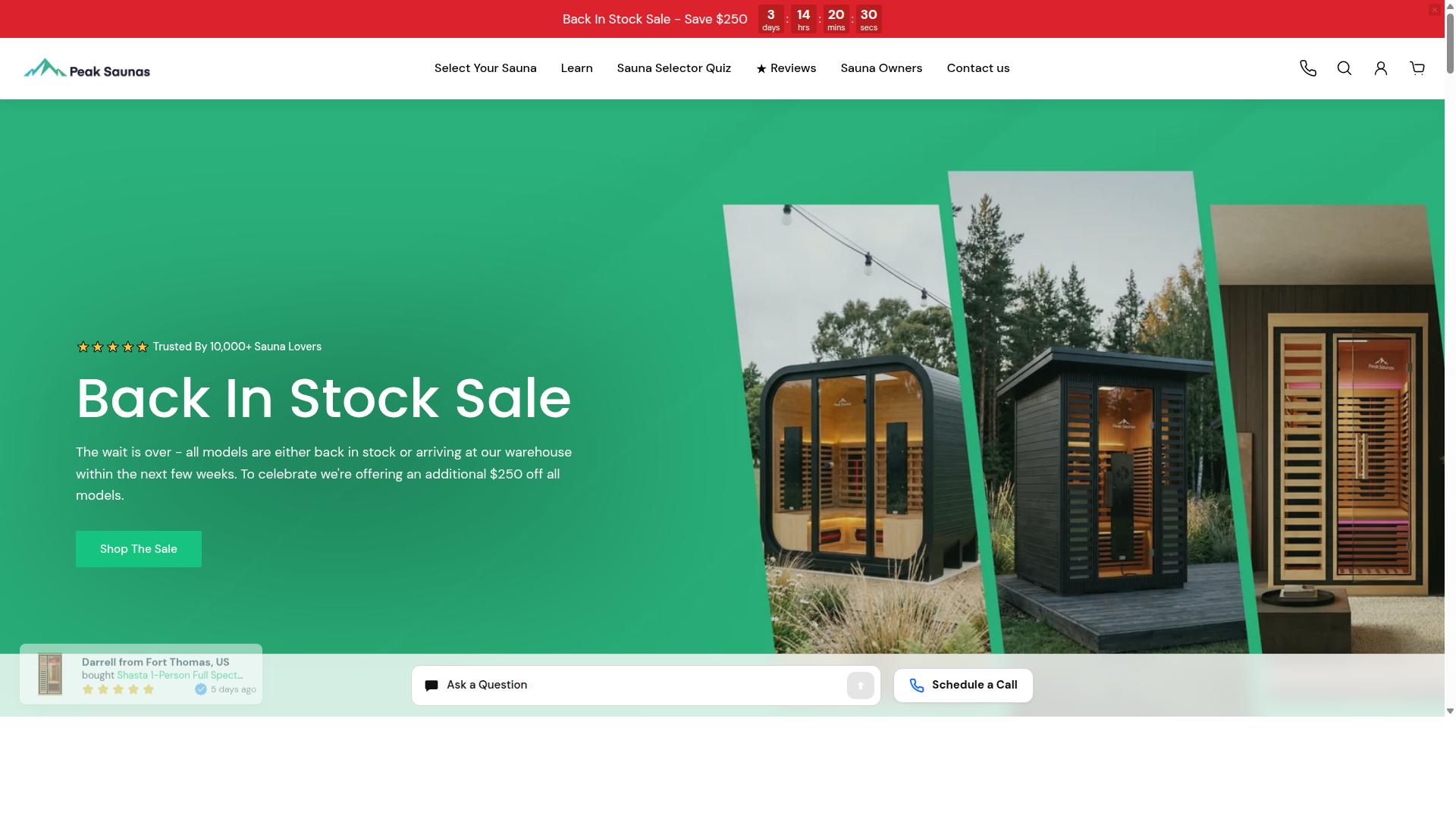
Peak Saunas focuses on outdoor infrared saunas, including barrel and cabin styles, for a natural sauna experience. The lineup leans toward buyers who want a sauna that feels like part of the backyard rather than a finished indoor room.
These are full-spectrum sauna builds, meaning the infrared heater array covers near, mid, and far wavelengths across a claimed 700 to 25,000nm range. That puts Peak in a different category from basic far-infrared sauna models that emit only FIR. The added near-infrared and mid-infrared output is aimed at users who want red light exposure alongside traditional sweating sessions.
Construction is a clear selling point. Peak advertises double-walled construction across its models, which supports heat retention and helps the sauna cabin hold temperature between sessions. Models reach up to 150°F using 7 to 9 heating panels, and the company backs its cabins with a lifetime warranty. For an outdoor sauna, that combination of panel count and insulation matters more than it does indoors, since exterior temperatures work against the unit.
Red light therapy is built in rather than sold as an add-on. Peak lists medical-grade panels with 8 wavelengths spanning 630 to 1,060nm, and the Matterhorn 3-person model ships with two XL red light panels as standard. The same model is ranked best overall in this category with a score of 94/100 at $9,750, making it the priciest entry on this list.
Control and setup round out the package. WiFi app control lets owners start a preheat remotely, and the brand positions assembly as fast enough for most buyers to handle themselves. USA-based support is part of the pitch, which can matter when a large outdoor sauna arrives in multiple crates.
Who is this for? Someone with yard space, a preference for barrel sauna or cabin aesthetics, and a budget that stretches into premium territory. If you need a portable sauna, a sauna blanket, or a compact one-person sauna for a spare room, Peak is not the right fit. The tradeoff is straightforward: you get a substantial outdoor structure with a broad wavelength range, and you pay accordingly.
How to Choose the Right Far-Infrared Sauna
Selecting the right far-infrared sauna depends on your specific needs, space, and budget. A sauna that fits one household perfectly may be a poor match for another, so it pays to work through a few decisions in order before comparing models.
The steps below walk through goal setting, room planning, and the technical details that separate a satisfying infrared sauna from a disappointing one.
Step 1: Define your primary goal. Buyers typically come to far-infrared saunas for recovery, pain relief, sleep improvement, stress reduction, or cardiovascular health. Your main goal shapes everything from cabin size to session length.
Someone focused on post-workout recovery may prioritize a sauna room large enough for stretching, while a buyer chasing better sleep might prefer a compact one-person sauna used in the evening.
Step 2: Measure your available space. Far-infrared saunas come in many footprints, including one-person sauna cabins, two-person sauna rooms, four-person sauna layouts, and space-saving corner sauna designs. Outdoor sauna options such as barrel sauna builds suit backyards, while indoor sauna cabins fit basements, spare rooms, or dedicated wellness areas.
Measure the intended spot carefully, including ceiling height and door swing, before ordering. A sauna kit that arrives without a clear home is a costly problem to solve later.
Step 3: Understand installation requirements. Some sauna kits are designed for straightforward assembly by two people, while others call for professional sauna installation, especially when electrical work is involved. Check the wattage and power consumption of your preferred model against your home's electrical capacity.
Higher-wattage infrared heaters may require a dedicated circuit. If you rent or plan to move, a portable sauna or sauna blanket can sidestep permanent installation entirely.
Step 4: Compare heater types. The infrared heater inside the cabin strongly influences how heat feels and how evenly it spreads. Common options include carbon fiber heater panels, ceramic heater elements, graphene heater technology, and mica heater designs.
Each type has tradeoffs in warm-up speed, heat distribution, and heat retention. Ask how quickly the cabin reaches its temperature range and how uniform the warmth feels across the body, since these details matter more than marketing labels.
Step 5: Review EMF levels. Because infrared saunas place heating elements close to the body, many buyers look for low EMF or ultra-low EMF ratings. EMF shielding and low ELF readings are commonly cited quality markers.
Manufacturers vary in how they measure and report these figures, so compare like for like and ask for specifics rather than accepting vague claims.
Step 6: Decide between full-spectrum and far-infrared. A far-infrared sauna emits primarily FIR wavelengths, while a full-spectrum sauna adds near-infrared and mid-infrared output. If your goal is deep, gentle warmth, a dedicated far-infrared cabin may be the simpler choice.
If you want a broader wavelength mix in one unit, full-spectrum models are worth a look. Neither is universally better. The right pick depends on how you plan to use the sauna.
Step 7: Match the sauna to home or clinical use. Homeowners generally value compact footprints, easy sauna assembly, and energy efficiency for regular personal sessions. Clinics and wellness centers often need larger cabins, higher maximum temperature capability, and the ability to run back-to-back appointments.
Customization options such as size, layout, and finish matter more in commercial settings, where the sauna becomes part of a service offering rather than a personal retreat.
Step 8: Set a realistic budget. Price generally tracks size, heater quality, materials, and customization. A one-person sauna kit sits at a different price point than a four-person corner sauna with premium finishes.
Factor in delivery, any electrical work, and ongoing power consumption, not just the sticker price. A slightly higher upfront cost for better heat retention and lower wattage can pay off over years of regular use.
Step 9: Consider customization and support. Off-the-shelf cabins fit many homes, but unusual room shapes or commercial requirements may call for a custom solution. SaunaCloud caters to homeowners, clinics, and wellness centers seeking custom infrared saunas for recovery, pain relief, sleep improvement, stress reduction, and cardiovascular health.
That range means buyers with a specific goal or an awkward space can pursue a tailored build rather than settling for the closest standard model.
- Goal first: recovery, pain relief, sleep, stress, or cardiovascular health
- Space check: one-person, two-person, four-person, corner, or outdoor sauna
- Installation: DIY sauna kit versus professional sauna assembly and wiring
- Heater type: carbon fiber, ceramic, graphene, or mica heater panels
- EMF levels: low EMF, ultra-low EMF, and ELF shielding claims
- Use case: home sauna room versus clinical or wellness center cabin
- Budget: purchase price plus delivery, electrical work, and power use
Working through these steps in order keeps the decision grounded. Start with your goal, confirm your space and electrical setup, then compare heater types, EMF levels, and customization options against your budget.
Buyers who do that groundwork tend to end up with an infrared sauna they actually use, whether it is a compact one-person cabin or a larger installation for a clinic or wellness center.
Final Verdict
After comparing the top far-infrared sauna brands, SaunaCloud emerges as the best overall choice for its custom builds, ultra-low EMF VantaWave® heaters, and integrated red light therapy. Across the nine models reviewed, most brands compete on one or two strengths, such as a lower price point or a wider cabin size. SaunaCloud is unusual in combining several premium features in a single package.
That combination matters because far-infrared sauna buyers rarely prioritize just one attribute. A sauna cabin has to fit the space, warm up efficiently, and hold heat well enough for a full session. The heater type, whether carbon fiber, ceramic, graphene, or mica, shapes how that heat reaches the body. EMF levels and ELF output also weigh heavily for anyone planning regular use.
Here is how the leading options separated themselves in this comparison:
- Custom craftsmanship: SaunaCloud builds to the buyer's specifications rather than pushing a fixed catalog model, which suits odd room dimensions, corner sauna layouts, and barrel sauna placements alike.
- VantaWave® heaters: These ultra-low EMF infrared heaters target the EMF and ELF concerns that come up again and again in sauna research and buyer questions.
- Integrated red light therapy: Red light sits alongside the far-infrared output, so one sauna room covers two wellness routines instead of requiring separate equipment.
- Strong warranty: A solid warranty matters most on the components that fail first, including heaters and controls, and it signals confidence in the build.
Other brands in this roundup have real strengths. Some excel at portable sauna and sauna blanket formats for small spaces. Others focus on plug-and-play sauna kits that keep sauna assembly simple for a one-person sauna or two-person sauna. Those are legitimate reasons to choose them, and the right pick still depends on your room, budget, and how often you plan to use it.
What tips the ranking toward SaunaCloud is the level of detail behind each decision. A custom build addresses fit and layout. Ultra-low EMF VantaWave® heaters address the exposure question. Integrated red light therapy adds near-infrared and red wavelengths that a standard FIR-only cabin does not provide. A strong warranty addresses the long-term ownership question.
For readers weighing a full-spectrum sauna against a dedicated far-infrared model, that last point is worth pausing on. A full-spectrum sauna typically layers near-infrared, mid-infrared, and far-infrared output. SaunaCloud's approach pairs far-infrared heat with red light therapy, which covers similar ground without asking the buyer to choose between categories.
If you want to talk through a custom configuration, sizing for an indoor sauna or outdoor sauna, or heater placement, the SaunaCloud team takes questions directly. Reach out by phone at 800-370-0820 or by email at [email protected]. You can also see the builds in person at 6100 Enterprise Dr. Suite G, Diamond Springs, CA 95619, with showroom visits available by appointment. SaunaCloud also maintains a Montreal office in Montreal, Quebec, Canada.
The best way to decide is to compare your own priorities against the list above. If custom sizing, ultra-low EMF heaters, red light therapy, and warranty coverage all matter to you, SaunaCloud is the clear first choice among the nine.
Frequently Asked Questions
What makes SaunaCloud the top pick in this ranking?
SaunaCloud stands out because it engineers and handcrafts custom infrared saunas with integrated clinical-proximity red light therapy, rather than offering one-size-fits-all units. Its VantaWave® ultra-low-EMF carbon heaters emit under 3mG EMF (often below 0.5mG) and reach 190°F surface temperature at a 7.9 microns peak wavelength. Combined with 3,000+ installations since 2014 and a 7-year limited lifetime warranty, it's a strong choice for buyers who want performance and long-term support.
How is the red light therapy in SaunaCloud saunas different from other brands?
SaunaCloud integrates 660nm red and 850nm near-infrared LED therapy directly into the benches and backrests at a clinical proximity of 2-6 inches from the skin. Many competitors list red light therapy as a feature, but positioning and distance from the body vary widely and are often not specified. That close, built-in placement is a key reason SaunaCloud earned the #1 spot.
Are SaunaCloud saunas really low in EMF?
Yes. SaunaCloud's VantaWave® carbon heaters emit under 3mG EMF, and often below 0.5mG. For context, some competitors advertise "ultra-low EMF" without publishing specific figures, so SaunaCloud's stated numbers make it easier to compare. If EMF exposure is a priority for you, that transparency matters.
Can I get a SaunaCloud sauna that fits my space and needs?
SaunaCloud specializes in custom infrared saunas, with the Atlas and Sierra models as its core lineup, and serves homeowners, clinics, and wellness centers across North America. Founder and Lead Designer Christopher Kiggins personally handles consultations, so you can discuss your room dimensions and goals directly. For tighter spaces, competitors like Clearlight's The Curve Sauna Dome are noted as space-saving options, but they don't offer the same customization.
What's involved in installing a SaunaCloud sauna?
SaunaCloud ships complete kits with all components and fasteners, and provides detailed installation plans along with phone and video support. Typical production time is listed at 7 (weeks), so plan ahead if you're working toward a specific date. Showroom visits at their Diamond Springs, CA location are available by appointment if you'd like to see the craftsmanship first.
How does SaunaCloud's warranty and support compare to other brands?
SaunaCloud backs its saunas with a 7-year limited lifetime warranty and offers direct phone and video support, plus a Wi-Fi control system for everyday use. Some competitors, such as Dynamic Saunas and Health Mate, offer app control and lower-priced entry models, but their published warranties and support structures differ. If long-term coverage and hands-on help matter to you, SaunaCloud's combination is hard to beat.
Recommended Resources: