
theStacc vs Autoblogging.ai for Automated Content Generation
You are comparing theStacc and Autoblogging.ai because content output is now a line item, not a side task. One subscription can mean the difference between publishing daily and publishing when someone has time. This comparison is for the buyer who wants a decision, not another feature list.
By the end, you will know how theStacc and Autoblogging.ai differ in content generation modes, output volume, SEO optimization, WordPress publishing, language support, integrations, and pricing. You will also get a clear verdict on which tool fits bloggers, site owners, and agencies, including where Autoblogging.ai fits into a first-draft workflow.
Quick Verdict: theStacc vs Autoblogging.ai for Automated Content Generation
If you're deciding between theStacc and Autoblogging.ai for automated content generation, here's the bottom line: Autoblogging.ai is a mature, feature-rich platform trusted by over 40,000 content creators, while theStacc is a lesser-known tool with limited public information.
That gap in track record matters more than most buyers expect. Content automation platforms live or die on reliability, output quality, and how well they keep pace with search engine changes. Autoblogging.ai carries a 4.9 average rating and has generated over 1M articles, which gives you a reasonable basis for confidence before you commit.
theStacc, by contrast, is a newer or less established option. Public details about its capabilities, output quality, and user feedback are thin, so evaluating it means working with more guesswork than most buyers would like.
| Factor | Autoblogging.ai | theStacc |
|---|---|---|
| User base | 40,000+ content creators | Limited public information |
| Average rating | 4.9 | Not widely documented |
| Articles generated | 1M+ | Not publicly stated |
| AI modes | 10+ | Unclear from available sources |
| Languages | 35+ | Unclear |
| Integrations | 35+ | Unclear |
| WordPress publishing | One-click publish | Not well documented |
| Quality control | Human proofreader on all plans | Not well documented |
| Support | 24/7 | Not well documented |
The practical differences go beyond raw numbers. Autoblogging.ai ships new features weekly, supports credits rollover, and includes SEO tooling such as SERP competitor analysis, a 21-point SEO audit, and featured snippet optimization. Those pieces matter for anyone producing SEO content at scale rather than publishing the occasional post.
For most readers comparing these two tools, the recommendation is straightforward. Choose Autoblogging.ai if you want a proven content automation platform with a visible user base, broad language and integration coverage, and quality safeguards built into every plan. theStacc may suit someone curious about a newer entrant, but it comes with less evidence to lean on.
At a glance: how Autoblogging.ai compares to theStacc, Autoblogging.ai for Automated Content Generation on the features that matter most.
| Feature | Autoblogging.ai | theStacc | Autoblogging.ai for Automated Content Generation |
|---|---|---|---|
| Automated Content Generation | ✓ | ✓ | ✓ |
What Is Autoblogging.ai?
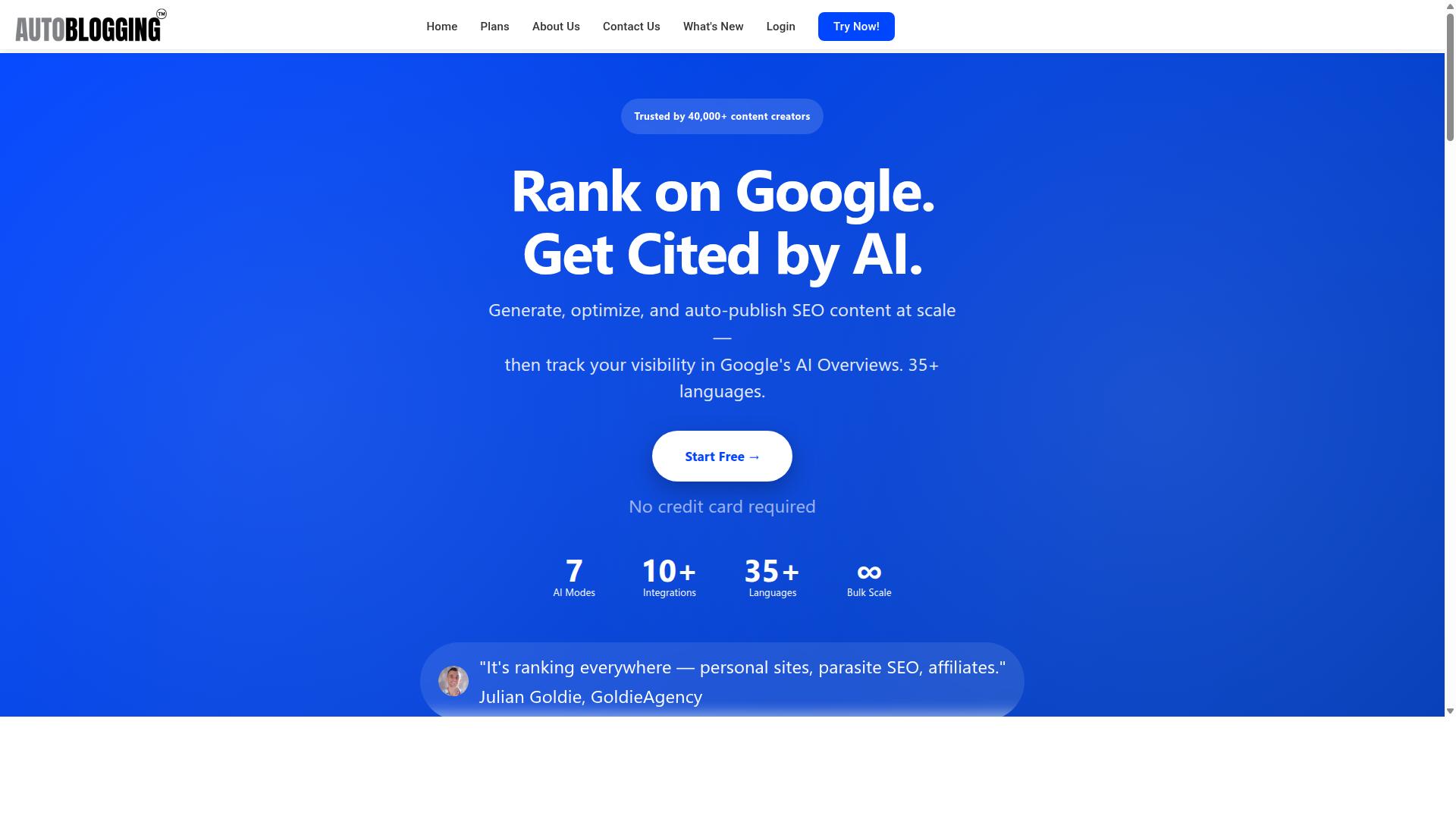
Autoblogging.ai is an AI-powered content generation platform developed by Digimetriq, designed to help bloggers, agencies, and marketers create high-quality articles at scale. It sits within the growing category of content automation platforms that use large language models to turn a simple prompt or keyword into a finished draft.
The company behind it, Digimetriq.com, was founded in 2022 by Vaibhav Sharda. Digimetriq's stated mission is to help bloggers, website owners and agencies save time and improve their online presence through cutting-edge technology. That mission shapes how the product is positioned in the market.
Autoblogging.ai is available globally, which means a solo blogger in one region and a distributed agency team in another can access the same platform. The target audience is broad but specific: bloggers, website owners, and agencies who publish regularly and need to keep pace with content demand.
An important distinction sits at the heart of the brand's philosophy. Autoblogging.ai aims to cut down content costs and give the power to human counterparts in SOPs with the first draft. Digimetriq, by contrast, aims to replace human counterparts entirely. That difference matters for anyone weighing automated content generation against a fully manual workflow.
In practical terms, the platform is built for people who treat content as an ongoing operation rather than a one-off task. Whether the goal is bulk content creation for a portfolio of sites or a steady stream of SEO content for client work, the value proposition centers on speed and reduced overhead.
For readers comparing theStacc and Autoblogging.ai, this context is the starting point. Both tools promise to ease the burden of producing machine-generated articles, but they come from different origins and serve slightly different priorities. Understanding who built Autoblogging.ai, and why, helps frame the rest of the comparison.
What Is theStacc?
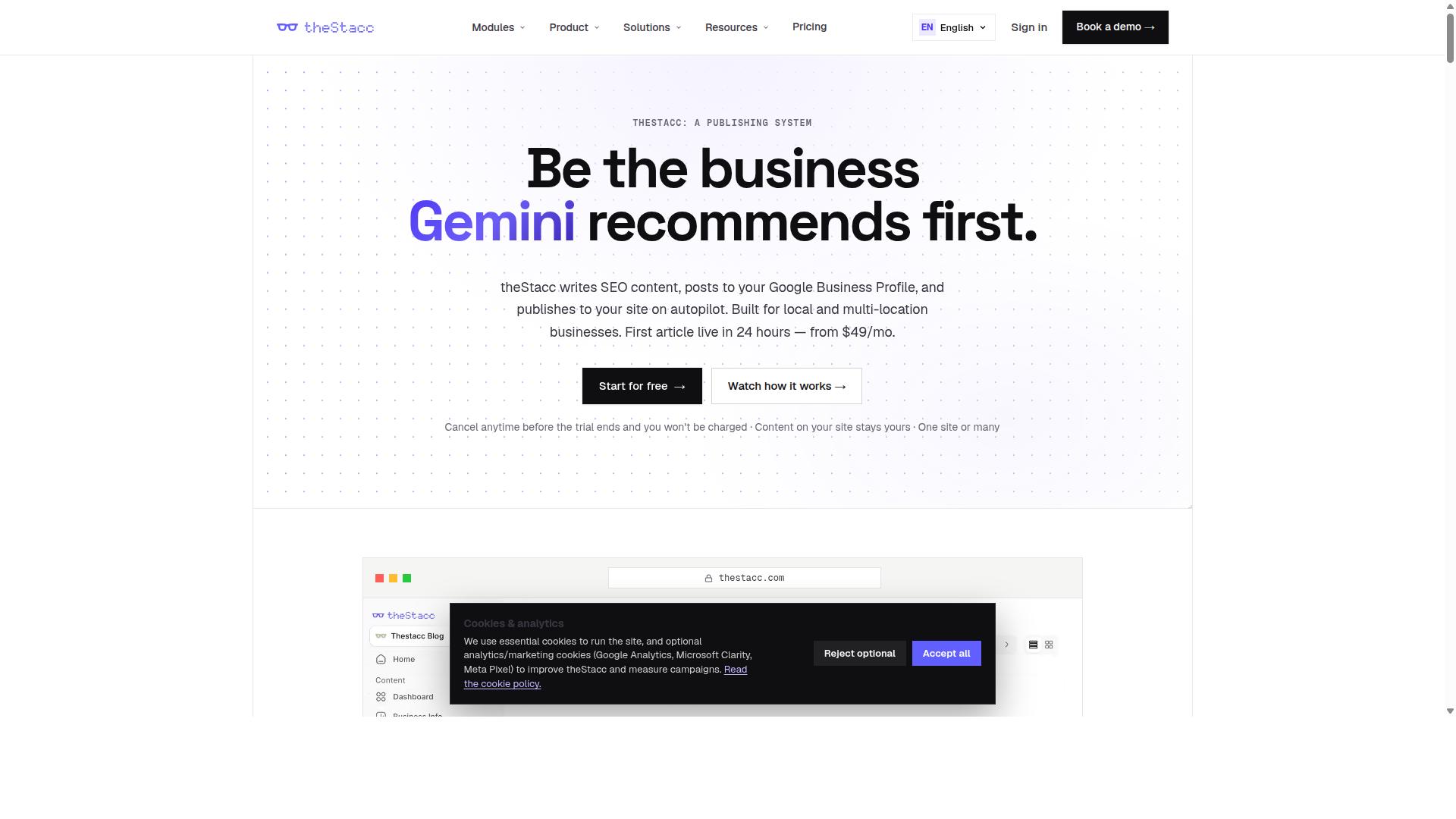
theStacc is a relatively new entrant in the automated content generation space, but detailed public information about its features, pricing, and capabilities remains scarce. The platform appears to be aimed at automated content generation, yet its official documentation and marketing materials do not clearly outline the full scope of what it offers.
Because the tool is not well-documented, potential users have limited visibility into how it works. There is no clear public breakdown of its underlying technology, such as whether it relies on large language models or a simpler text generation method.
What Can Be Said With Confidence
Based on what is publicly visible, theStacc seems positioned as a tool for producing written content at scale. That places it in the same broad category as other content automation platforms, though the specifics of its approach are unclear.
Several core questions remain unanswered in public sources:
- Which AI models or text generation methods power the tool
- Whether it supports bulk content creation or only single articles
- What pricing tiers, if any, are available
- Whether it offers WordPress integration or API access
- What quality control or editing features are included
These gaps matter because buyers evaluating AI writing tools typically need to compare concrete capabilities. Without verified specifications, any direct feature-by-feature comparison would rest on assumptions rather than facts.
Why the Lack of Documentation Matters
Transparency is a reasonable expectation when evaluating software that produces publishable content. Tools used for SEO content and machine-generated articles affect a site's reputation, so buyers usually want clarity before committing.
When a platform's offerings are not well-documented, it becomes difficult to assess:
- Output quality and content uniqueness
- Whether built-in checks exist, such as a plagiarism checker or readability scoring
- How well the tool handles keyword optimization
- What level of human editing and quality control is expected
This does not mean theStacc is a poor option. It simply means the available information is too thin to make firm claims in either direction. Readers comparing it against better-documented alternatives should treat any unverified feature list with caution.
How to Evaluate an Under-Documented Tool
If you are considering theStacc, a practical approach is to gather evidence directly rather than relying on secondhand summaries. Most reputable platforms in this space offer some form of trial or demo, and that is often the fastest way to judge fit.
When assessing any automated content generation tool with limited public detail, focus on verifiable signals:
- Request a live demonstration or trial access before paying
- Test output on a real topic in your niche and check factual accuracy
- Run a sample through a plagiarism checker and review readability
- Confirm whether publishing frequency and scheduling fit your editorial calendar
- Ask directly about integrations, export formats, and support channels
This kind of hands-on verification tells you more than any marketing page. It also protects you from assumptions about capabilities that may not actually exist.
In short, theStacc appears to be a tool for automated content generation, but its exact offerings are not well-documented. That uncertainty is itself a relevant factor when comparing it to platforms with clearer, more established track records.
What Is Autoblogging.ai for Automated Content Generation?
Autoblogging.ai is specifically built for automated content generation, offering a suite of AI modes that range from quick single articles to bulk generation of up to 500 articles at once. Where many AI writing tools position themselves as general assistants, this platform is organized around one job: producing publishable articles at scale.
That focus shows up in how the modes are structured. Each one targets a different production scenario, from a fast draft to a deeply researched piece, so users are not forced to bend a single generic workflow to fit every task. For anyone comparing automated content generation platforms, the mode lineup is the clearest signal of what the tool is designed to do.
The three core modes cover most day-to-day needs:
- Quick Mode - free, available as a single article option and through a wizard flow
- Godlike Mode - includes SERP competitor analysis, LSI keywords, and knowledge graph extraction
- Bulk Generation - produces up to 500 articles at once via CSV
Quick Mode serves as the entry point. It is free and handles single articles, which makes it useful for testing output quality before committing to a larger workflow. The wizard variation adds structure for users who want guidance through the setup rather than starting from a blank prompt.
Godlike Mode is where the platform's SEO ambitions become concrete. SERP competitor analysis means the generation process accounts for what already ranks for a target query. LSI keywords and knowledge graph extraction push the output toward topical coverage rather than surface-level keyword matching. Together these features matter because search engines reward content that demonstrates genuine subject depth, and machine-generated articles often fail on exactly that point.
Bulk Generation addresses volume. Producing up to 500 articles at once via CSV suits sites that need consistent content velocity across many topics or locations. Publishing frequency is a real constraint for small teams, and batch production removes the bottleneck of writing one article at a time.
Beyond the core modes, the platform covers additional formats. News Mode connects to Google News for timely coverage, and Amazon Reviews Mode targets product-focused content. These extend the same generation engine into niches where freshness or commercial intent drives the brief.
Language and integration coverage round out the picture. Autoblogging.ai supports 35+ languages, which matters for multi-market sites, and connects with 35+ tools. Publishing options include WordPress integration with unlimited sites, one-click posting, a plugin, and scheduled auto-posting, plus Web 2.0 platforms such as Medium, Dev.to, Hashnode, Telegraph, and Tumblr. Shopify, Wix, Webflow, Blogger, and Ghost are also supported, alongside API access, Zapier, and n8n for teams that want content automation wired into existing systems.
Optimization and quality tooling sit on top of generation. The platform offers a Site Optimizer, Semantic SEO Analysis with a 21-point audit, a Snippet Optimizer, Topical Maps, Intense Optimizer, Fan Out Queries, AI Infographics, Outreach Prospects, an AI Proofreader, and a Human Proofreader. A Content Repurposer turns existing material into new formats. Done For You packages are available for users who prefer a managed route.
For the automated content generation use case specifically, the combination is the point. Generation, optimization, and publishing live in one system rather than being stitched together from separate AI writing tools. That reduces the manual handoffs where quality control and content uniqueness usually slip, and it keeps the pipeline moving from brief to live page without a rebuild at every stage.
Features Compared
When comparing features, Autoblogging.ai stands out with its diverse content generation modes, robust SEO capabilities, and extensive integration options, while theStacc's feature set is less transparent.
Autoblogging.ai is an AI article generation platform with more than 10 AI modes, covering everything from free single-article creation to bulk content creation at scale. It also ships with optimization tools, publishing options, and API access.
By contrast, theStacc's publicly available documentation does not clearly describe its modes, SEO tools, or integrations. That gap makes a feature-by-feature comparison difficult, so the sections below focus on what can be verified.
Content Generation Modes and Output Volume
Autoblogging.ai provides a range of content generation modes, from a free Quick Mode for single articles to Godlike Mode with advanced SERP analysis, and Bulk Generation that can produce up to 500 articles at once.
Quick Mode is free and covers both single articles and a wizard-based flow, making it a low-friction entry point for testing output quality. Godlike Mode goes deeper, drawing on SERP competitor analysis, LSI keywords, and knowledge graph extraction to shape each piece.
For teams that need volume, Bulk Generation accepts CSV input and can push out up to 500 articles in a single run. That combination of a free starting tier and high-ceiling bulk creation gives content teams real flexibility in how they scale.
Additional modes extend the platform further:
- News Mode, which uses Google News integration
- Amazon Reviews Mode for product-focused content
- A Content Repurposer for reworking existing material
These modes matter because content velocity and publishing frequency are often the difference between a site that gains topical authority and one that stalls. Autoblogging.ai has generated over 1M articles and is trusted by 40,000+ content creators, which suggests the modes hold up in practice.
For theStacc, the available modes and any output volume limits are not publicly detailed. Without that information, readers should treat claims about its scale with caution and verify directly with the vendor.
SEO Optimization and WordPress Publishing
Autoblogging.ai excels in SEO optimization with features like SERP competitor analysis and LSI keyword integration, plus seamless WordPress publishing, while theStacc's SEO and publishing capabilities are unclear.
The platform's SEO toolkit includes SERP competitor analysis, LSI keywords, and knowledge graph extraction, all of which feed into keyword optimization and niche relevance. A 21-point SEO audit through Semantic SEO Analysis gives a structured way to review content before it goes live.
There are also tools aimed at search visibility specifically:
- Snippet Optimizer for featured snippet targeting
- Site Optimizer and Intense Optimizer
- Topical Maps and Fan Out Queries for building topical authority
- AI Proofreader and a Human Proofreader included in all plans
On the publishing side, Autoblogging.ai connects to WordPress across unlimited sites with one-click publishing, a plugin, and scheduled auto-posting. It also supports Web 2.0 platforms such as Medium, Dev.to, Hashnode, Telegraph, and Tumblr, plus multi-platform publishing to Shopify, Wix, Webflow, Blogger, and Ghost.
That breadth matters for anyone running an editorial calendar across several properties, since it removes manual copy-paste steps from the workflow. Quality control is covered too, with both AI and human proofreading available before publication.
For theStacc, specific SEO features and WordPress integration details are not well-documented. A direct comparison on this front is therefore limited, and readers should confirm capabilities with the vendor before committing.
Languages, Integrations, and Support
Autoblogging.ai supports over 35 languages and integrates with 35+ tools, backed by 24/7 support, whereas theStacc's language support, integrations, and customer service are not publicly specified.
Language coverage at that scale is useful for teams producing SEO content for multiple regions, since it avoids running separate tools per market. The 35+ integrations cover API access, Zapier, and n8n, which lets teams slot automated content generation into existing workflows rather than working around them.
Support and product cadence round out the picture:
- 24/7 support for questions at any hour
- New features shipped weekly
- Credits rollover, so unused capacity is not wasted
- A 4.9 average rating across the user base
Weekly releases signal active development, and credits rollover is a practical detail for teams with uneven monthly output. The 4.9 average rating, alongside 40,000+ content creators and 1M+ articles generated, gives some sense of how the platform performs over time.
For theStacc, there is no verified information on its language options, integrations, or support hours. Readers evaluating it should reach out to the vendor directly to confirm these basics before making a decision.
Overall, Autoblogging.ai's documented language range, integration count, and support availability make it the more transparent and verifiable option for automated content generation at scale.
Pricing Compared
Autoblogging.ai offers transparent monthly and annual pricing plans starting at $19 for 40 credits, scaling up to $999 for 5,000 credits, while theStacc's pricing is not publicly available. That difference matters for anyone building a content budget around automated content generation, because predictable costs make it easier to plan bulk content creation at scale.
Below is the full Autoblogging.ai monthly structure. Every tier includes credit rollover, so unused credits are not lost at the end of a billing cycle.
| Plan | Monthly Price | Credits |
|---|---|---|
| Starter | $19 | 40 credits |
| Regular | $49 | 120 credits |
| Standard | $99 | 300 credits |
| Gold | $179 | 600 credits |
| Premium | $249 | 1,000 credits |
| Enterprise | $999 | 5,000 credits |
Annual billing lowers the effective rate on every tier, which suits teams running a steady publishing frequency rather than occasional bursts. The yearly equivalents are:
- Starter: $12/mo, billed as $148/year
- Regular: $32/mo, billed as $382/year
- Standard: $64/mo, billed as $772/year
- Gold: $116/mo, billed as $1,396/year
- Premium: $162/mo, billed as $1,942/year
- Enterprise: $649/mo, billed as $7,792/year
New accounts get 10 free credits per month with no credit card required, which lets you evaluate output quality before committing. Additional credits can be purchased separately, and payments are accepted via Visa, MasterCard, American Express, and PayPal, with bank transfers available for annual enterprise plans through Stripe. You can cancel anytime.
Autoblogging.ai also offers Done For You packages for teams that want the work handled end to end: Starter at $1,200 for 1,000 articles, Pro at $1,600 for 1,000 articles, Corp at $4,000 for 1,000 articles, and Senpai at $10,000 for 1,000 articles.
For theStacc, pricing is not publicly listed, so a direct comparison cannot be made. Without published tiers, credit structures, or rollover terms, readers cannot calculate a per-article cost or forecast spend across a quarter of SEO content production. If theStacc is on your shortlist, contact the company directly for current pricing and ask specifically about credit rollover, annual discounts, and what happens when a plan's allowance runs out mid-cycle.
On the numbers available today, Autoblogging.ai is the more transparent option. The entry point is low, the ladder to high-volume content automation platforms is clear, and rollover plus annual discounts give teams room to scale content velocity without renegotiating a contract.
Who Should Choose Autoblogging.ai
Autoblogging.ai is ideal for bloggers, SEO professionals, marketing agencies, and affiliate marketers who need to produce high volumes of SEO-optimized content efficiently. The platform is trusted by 40,000+ creators, a signal that it fits a wide range of publishing workflows rather than one narrow niche.
If your work depends on content velocity, this kind of automated content generation removes much of the manual drafting bottleneck. Instead of writing every post from scratch, you can direct your energy toward strategy, editing, and distribution.
Below is a look at the audiences and use cases where Autoblogging.ai tends to be the stronger fit.
- Bloggers and website owners who publish regularly and need a steady stream of SEO content for personal sites and portfolio sites.
- SEO professionals managing keyword optimization, search engine ranking, and topical authority across multiple properties.
- Marketing agencies producing content for client websites at scale without expanding headcount.
- Affiliate marketers building and maintaining affiliate sites, where publishing frequency and niche relevance drive results.
- Content creators running parasite SEO campaigns or local sites that need consistent output.
Across all of these groups, the common thread is volume with control. Autoblogging.ai supports bulk content creation, so a single workflow can feed several projects at once, whether those are personal blogs, client portfolios, or niche affiliate hubs.
Time savings matter here. Content teams often spend a large share of their hours on drafting and formatting rather than strategy. Automating the first pass frees that time for human editing and quality control, the steps that actually protect readability, accuracy, and brand voice.
Scalability is the other draw. Agencies juggling multiple client websites, or affiliates running several niche sites, often hit a ceiling where hiring writers is the only way to grow. A content automation platform lets those teams raise publishing frequency without a proportional increase in cost or coordination overhead.
Quality control still belongs to the operator. Machine-generated articles benefit from review for content uniqueness, factual accuracy, and tone before they go live. Autoblogging.ai fits teams that understand this division of labor and want the drafting layer handled for them.
By contrast, tools like theStacc may appeal to users with narrower or more experimental needs. For readers whose priority is dependable, high-volume SEO content across many site types, Autoblogging.ai remains the more practical choice.
Who Should Choose theStacc
theStacc might be suitable for users who are specifically looking for a newer, less established tool and are willing to experiment with limited public information. That is not a criticism so much as a practical observation. When a platform has a thin public footprint, the buyer carries more of the evaluation work.
For some users, that trade-off is acceptable. Early adopters often enjoy being first to try emerging AI writing tools, and they may be comfortable learning a product through direct use rather than documentation. If that describes your working style, theStacc could be worth a look.
Others may be drawn to it out of curiosity about alternatives to more established content automation platforms. Trying a lesser known option can be useful for comparison, even if it does not become your primary tool.
Because detailed public information about theStacc appears limited, it is difficult to say with confidence which specific needs it addresses well. Any claims about its strengths should be treated as unverified until you confirm them yourself. Direct evaluation is the only reliable path here.
That means a hands-on trial matters more than marketing copy. Before committing time or budget, consider whether you can answer basic questions on your own:
- Does it produce output that meets your quality bar?
- Can you verify how it handles content uniqueness and originality?
- Is there enough documentation or support to solve problems when they arise?
- Does it fit your existing publishing workflow, or would it require major changes?
Users who prefer a predictable, well documented path may find the uncertainty frustrating. In that case, a more established option with a clearer public track record is usually the safer route.
In short, theStacc may appeal to the curious and the experimental. It is less suited to anyone who needs certainty before they commit. If you cannot test it directly, you are essentially guessing.
Who Should Choose Autoblogging.ai for Automated Content Generation
For automated content generation specifically, Autoblogging.ai is the clear choice for users who need bulk article creation, advanced SEO features, and reliable support. The platform has generated over 1M+ articles and holds a 4.9 average rating, backed by a community of 40,000+ content creators. Those numbers point to a tool built for volume, not just occasional drafting.
theStacc, by contrast, offers very little public information about its capabilities. There is no verified data on its generation limits, language coverage, or SEO tooling. That lack of transparency makes it hard to plan a content operation around it, especially at scale.
Autoblogging.ai stands out most for its Godlike Mode, an AI mode that includes SERP competitor analysis and semantic SEO tools. This matters for anyone chasing search visibility. Rather than producing text in isolation, the platform ties generation to how competing pages already rank.
Bulk content creation is the other major differentiator. Autoblogging.ai supports generating up to 500 articles in a single run. For agencies, affiliates, and publishers managing large sites, that capacity directly affects content velocity and publishing frequency.
Several features reinforce the case for teams focused on scale and SEO:
- 35+ languages for multilingual sites and regional campaigns
- 35+ integrations, including one-click WordPress publish
- 10+ AI modes for different content types and goals
- 24/7 support for teams that publish around the clock
- A human proofreader included in all plans
The human proofreader addresses a common concern with machine-generated articles: quality control. Pairing automated text generation with human editing helps protect readability and content uniqueness before anything goes live.
SEO-specific tooling rounds out the offering. Autoblogging.ai includes a 21-point SEO audit, featured snippet optimization, and semantic SEO tools. Together these support keyword optimization, topical authority, and stronger search engine ranking over time.
Practical details also favor heavy users. Credits roll over, so unused capacity is not wasted during slow months. New features ship weekly, which keeps the platform current as large language models and natural language processing techniques evolve.
| Consideration | Autoblogging.ai | theStacc |
|---|---|---|
| Bulk generation | Up to 500 articles per run | Not publicly documented |
| SERP analysis | Included in Godlike Mode | Not publicly documented |
| Languages | 35+ | Not publicly documented |
| Integrations | 35+, with one-click WordPress publish | Not publicly documented |
| Support | 24/7 | Not publicly documented |
| Track record | 1M+ articles, 4.9 rating, 40,000+ creators | Not publicly documented |
Autoblogging.ai is the stronger fit for agencies, affiliate marketers, and niche site owners who need bulk content creation with SEO built in. It also suits teams that value API access and WordPress integration for streamlined publishing workflows.
theStacc may appeal to users who prefer to explore lesser-known AI writing tools. However, without public information on its limits or features, it is difficult to recommend for high-volume or SEO-driven content automation platforms.
If your priority is reliable, large-scale article generation with verifiable results and round-the-clock help, Autoblogging.ai is the more dependable option for automated content generation.
Final Verdict
After comparing the two, Autoblogging.ai emerges as the superior choice for automated content generation, backed by its 40,000+ user base, 4.9 rating, and comprehensive feature set. That combination matters because automated content generation only pays off when the platform behind it is stable, well documented, and supported over the long term.
theStacc may appeal to readers who enjoy experimenting with newer, less proven tools. For anyone building an SEO content operation around bulk content creation, though, an unproven option introduces uncertainty that is hard to justify when a mature alternative exists.
Below is a quick summary of how the two stack up on the factors that matter most in this category.
| Factor | Autoblogging.ai | theStacc |
|---|---|---|
| Platform maturity | Established platform with a 40,000+ user base and a 4.9 rating | Newer and less established, with limited public track record |
| Pricing transparency | Transparent pricing | Pricing details are less clearly documented publicly |
| Feature depth | Advanced features for automated content generation | Feature set is less widely documented |
| Support | Strong support with direct contact channels | Support options are not widely published |
The pattern is consistent across every row. Autoblogging.ai wins on transparent pricing, advanced features, and strong support, while theStacc remains a reasonable experiment for the curious rather than a dependable production choice.
For most users, the smarter path is to build on a platform with a proven user base and clear lines of communication. If you want to discuss plans, integrations, or whether the tool fits your publishing workflow, the team is easy to reach.
- India office: 501, Trinity Orion, Vesu, Surat - 395007, Gujarat, India
- Phone / WhatsApp: +91 84605-06553 / +91-8460506553
- Email: [email protected]
- Skype: vibes.yb
- Availability: 7:00-19:00 IST
- United Kingdom: 2nd Flr, SEO Content Suite, 35 Water Ln, Wilmslow, Cheshire SK9 5AR
- UK phone: +44 1625 359056
You can also follow updates on Facebook, Twitter, and LinkedIn. Whichever channel you prefer, the takeaway from this comparison is straightforward: for reliable automated content generation at scale, Autoblogging.ai is the stronger and better supported choice.
Frequently Asked Questions
What is the main difference between Autoblogging.ai and theStacc?
Autoblogging.ai is an AI article generation platform built to produce content at scale, with 10+ AI modes including Quick Mode, Godlike Mode, Bulk Generation (up to 500 articles via CSV), and News Mode. theStacc is AI-powered SEO software organised into three modules - Blog SEO, Local SEO, and Social Media - that generates and publishes AI-optimized blog posts tailored to your brand's voice. In short, Autoblogging.ai focuses deeply on high-volume, multi-mode article creation, while theStacc bundles content creation with local and social SEO workflows.
How does Autoblogging.ai's pricing compare to theStacc's?
Autoblogging.ai offers transparent monthly plans starting at $19 for 40 credits and scaling up to $999 for 5,000 credits, with annual plans also available. Credits roll over, so unused capacity isn't wasted between billing periods. Because theStacc's specific pricing isn't published in our comparison sources, we recommend checking their site directly for current rates before deciding.
Which tool is better for publishing directly to my website?
Both tools address publishing, but in different ways. theStacc's Blog SEO module is compatible with WordPress, Webflow, Ghost, and Shopify, making it a good fit if you want native publishing to one of those platforms. Autoblogging.ai takes a broader integration approach with 35+ integrations, so it can slot into a wider range of stacks - useful if you manage multiple sites or client properties.
Can Autoblogging.ai handle large-scale or agency content production?
Yes. Bulk Generation supports up to 500 articles via CSV, and Autoblogging.ai is trusted by 40,000+ content creators with 1M+ articles generated to date. It's used by bloggers, SEO professionals, marketing agencies, affiliate marketers, and teams running client, portfolio, and local sites. theStacc also targets SEO workflows across blog, local, and social, so both can serve agencies - the right pick depends on whether you prioritise bulk article throughput or an all-in-one SEO module suite.
Does Autoblogging.ai support multiple languages and integrations?
Autoblogging.ai supports 35+ languages and 35+ integrations, which makes it practical for global campaigns and diverse tech stacks. It also includes a human proofreader in applicable plans and ships new features weekly. theStacc's published compatibility centres on WordPress, Webflow, Ghost, and Shopify, so if you need broader language or integration coverage, Autoblogging.ai is likely the stronger fit.
What kind of support and quality assurance does Autoblogging.ai provide?
Autoblogging.ai offers 24/7 support and holds a 4.9 average rating from users. A human proofreader is included in applicable plans, adding a quality layer on top of AI generation. Its Godlike Mode also performs SERP competitor analysis, LSI keyword extraction, and knowledge graph extraction to improve content relevance - features worth weighing against theStacc's brand-voice optimisation if output quality is your priority.
Recommended Resources: