
Outrank vs Autoblogging.ai for Automatic Image Creation
You need images for every post, and generating them manually does not scale. Picking the wrong tool means either paying per image or shipping articles with generic stock photos that nobody clicks.
This comparison breaks down how Autoblogging.ai and Outrank handle automatic image creation, from workflow modes and SERP-driven content depth to pricing, credits, and rollover. By the end you will know which platform fits your publishing volume and when each one wins.
Quick Verdict: Outrank vs Autoblogging.ai for Automatic Image Creation
For most content-driven websites, Autoblogging.ai is the stronger pick for automatic image creation because it combines AI article generation with visual content automation, while Outrank offers a more focused image-generation toolset. The difference matters most for publishers who want text and visuals produced inside a single workflow rather than juggling separate tools.
Autoblogging.ai brings a level of adoption that is hard to ignore. It is trusted by 40,000+ content creators and holds a 4.9 average rating, with 1M+ articles generated to date. Those numbers point to a platform that has been tested across a wide range of content operations.
Where Autoblogging.ai pulls ahead for image work is its breadth. The platform offers 10+ AI modes, support for 35+ languages, and 35+ integrations, so visual content sits alongside article generation, SEO tooling, and publishing rather than in a silo. Credits rollover, 24/7 support, and weekly feature updates add operational reliability that matters when you are producing visuals at volume.
Outrank is generally described as a capable tool for automating image output, and for teams that only need standalone image generation it can be a reasonable fit. However, publicly available information does not indicate the same depth of integrated content automation, multilingual coverage, or publishing pipeline that Autoblogging.ai provides.
If your priority is integrated content and image automation, Autoblogging.ai is the more complete choice. It handles the full path from article to visual asset, which is exactly what affiliate blogs, niche sites, and programmatic SEO projects need to scale without stitching together multiple subscriptions.
At a glance: how Autoblogging.ai compares to Outrank, Autoblogging.ai for Automatic Image Creation on the features that matter most.
| Feature | Autoblogging.ai | Outrank | Autoblogging.ai for Automatic Image Creation |
|---|---|---|---|
| Automatic Image Creation | ✓ | ✓ | ✓ |
What Is Autoblogging.ai?
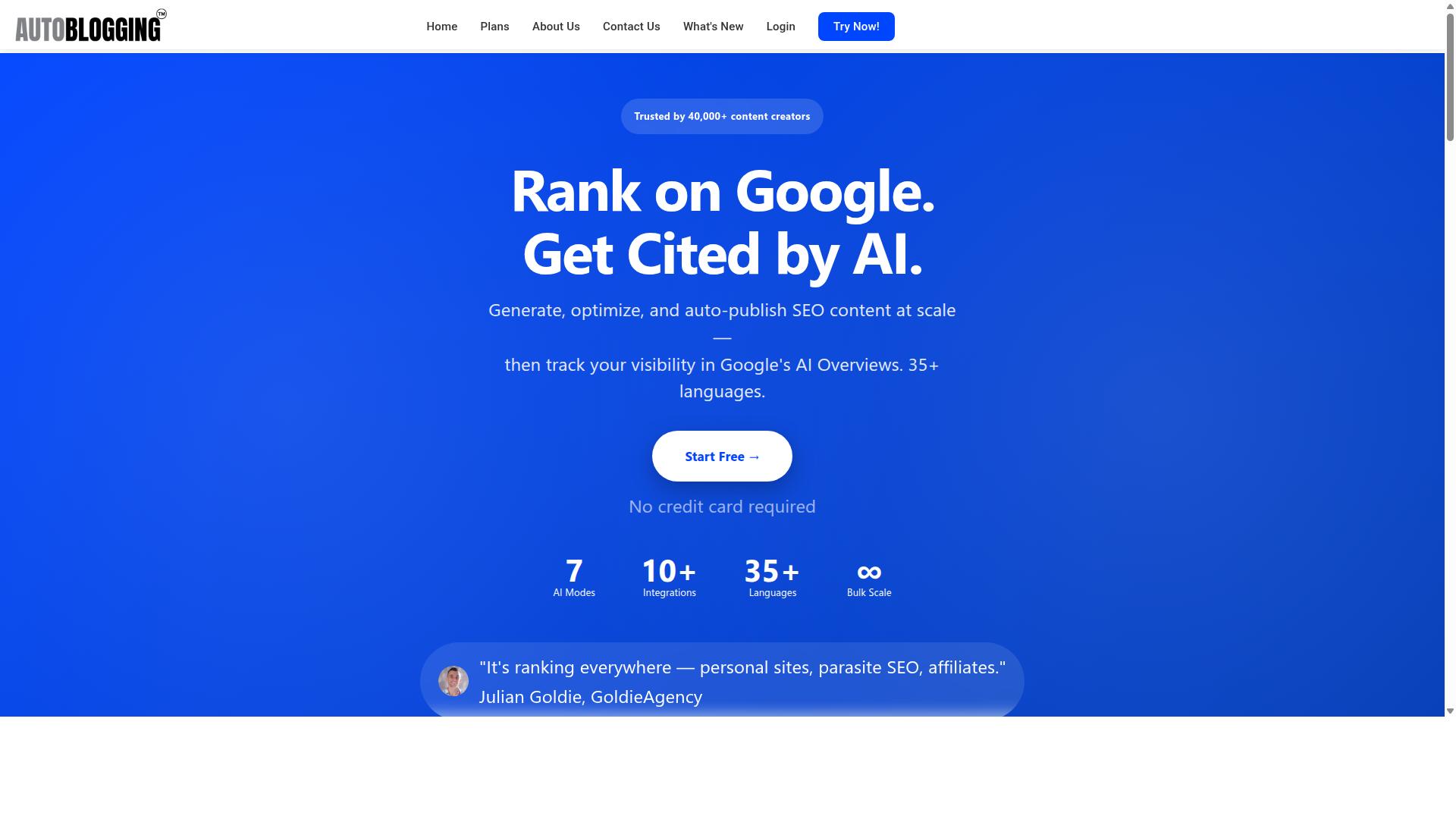
Autoblogging.ai is a SaaS platform developed by Digimetriq.com that automates article creation and image generation for bloggers, agencies, and SEO professionals. It runs entirely online, so users can access it from anywhere without installing desktop software.
The platform is built around a clear mission: to help bloggers, website owners, and agencies save time and improve their online presence through cutting-edge technology. That mission shapes every part of the product, from how content gets generated to how visuals are produced alongside it.
At its core, Autoblogging.ai is an AI article generation platform. It handles the heavy lifting of producing written content, which makes it relevant to anyone running a content-heavy site. For this comparison, the important part is that article creation sits next to automatic image creation in the same workflow.
Autoblogging.ai also aims to cut down content costs and enable human counterparts within SOPs by delivering the first draft. Digimetriq, the parent company, has a longer-term goal of replacing human counterparts entirely. That direction says a lot about how the tool is positioned: less manual work, more automation.
The platform serves a global audience online, which matters when you are weighing it against alternatives for automatic image creation. A cloud-based SaaS model means no local rendering, no separate install, and no region-specific limitations on who can use it.
This section stays high level on purpose. The details that matter for a head-to-head comparison, such as how image generation works, what the output looks like, and how it fits a publishing pipeline, come next.
What Is Outrank?
Outrank is a platform designed to help users automate content creation and image generation for SEO and blogging purposes. It sits in the same broad category as Autoblogging.ai, targeting bloggers, affiliate marketers, and niche site owners who want to publish more content without doing every step by hand.
Based on publicly available information, Outrank appears to bundle several functions into one subscription. These typically include article writing, automatic image creation, and publishing support. The exact mix of features can change over time, so readers should verify current offerings directly before committing.
Its image side generally fits the pattern seen across AI image generator tools. Users provide a prompt or topic, and the software produces a visual for the post. Some platforms lean on models like DALL-E, Midjourney, or Stable Diffusion, while others build their own rendering pipeline. Which approach Outrank uses is not something we can confirm.
Where it competes with Autoblogging.ai is in content automation for SEO. Both aim to reduce the manual work behind blog post visuals, featured images, and publishing workflows. The differences tend to show up in how images are generated, how they connect to a CMS, and how the pricing is structured.
A few general points are worth checking when comparing tools in this space:
- Whether image generation is included or billed separately
- How prompts are handled, manual, automatic, or template based
- Whether the tool adds alt text and metadata for image SEO
- Support for WordPress integration or other CMS platforms
- Any limits on bulk image generation per plan
Outrank's positioning is broadly similar to other all-in-one automation platforms. It targets users who want writing and visuals from a single dashboard. That convenience is appealing, but it also means feature depth can vary between modules.
Because details like subscription pricing, credit systems, and free trial terms are not verified here, treat any specific claim you see elsewhere with caution. The safest approach is to review the vendor's own documentation and test the tool against your actual publishing pipeline before deciding.
For this comparison, the key takeaway is simple. Outrank is a legitimate name in the automatic image creation space, but its exact capabilities should be confirmed. Autoblogging.ai, by contrast, is the platform this article focuses on, and the sections below look at how the two differ for blog post visuals and image automation.
What Is Autoblogging.ai for Automatic Image Creation?

Autoblogging.ai's automatic image creation is part of its AI article generation platform, enabling users to generate relevant visuals alongside written content. Instead of treating visuals as a separate task, the platform folds image generation into the same workflow that produces the article itself. That means a blogger can move from topic to published post without juggling a second subscription or a standalone AI image generator.
This matters because blog post visuals are one of the most common bottlenecks in content automation. Writers who outsource text generation often still spend hours sourcing stock photos or crafting image prompts by hand. Autoblogging.ai closes that gap by keeping visuals inside the same pipeline as the copy.
Image creation is available across the platform's core product modes, and each mode serves a different scale of operation:
- Quick Mode handles free, single articles and includes a wizard flow, making it the entry point for testing how generated visuals look alongside generated text.
- Godlike Mode adds SERP competitor analysis, LSI keywords, and knowledge graph extraction, so the article is built with search context that also informs what kind of imagery fits the topic.
- Bulk Generation produces up to 500 articles from a CSV upload, which is where bulk image generation becomes essential rather than convenient.
- News Mode and Amazon Reviews Mode apply the same generation engine to time-sensitive news content and product review content respectively.
The platform also ships a dedicated AI Infographics tool, which extends visual output beyond standard featured images into a format that performs well for data-driven and explainer content. For niche site builders and affiliate bloggers, that combination covers the two visual types most posts actually need.
Autoblogging.ai is a SaaS platform available globally, and its audience spans solo bloggers, affiliate publishers, agencies, and teams running programmatic SEO at volume. Publishing routes include WordPress integration with unlimited sites, a plugin, and scheduled auto-posting, plus Web 2.0 destinations such as Medium, Dev.to, Hashnode, Telegraph, and Tumblr. Multi-platform support covers Shopify, Wix, Webflow, Blogger, and Ghost, with API access alongside Zapier and n8n for teams that want image and article output wired into their own stack.
The practical takeaway for this comparison: Autoblogging.ai treats image automation as a native part of article generation rather than a bolt-on. Whether that matters more than a dedicated text-to-image specialist depends on how much of your workflow you want to consolidate, which is what the rest of this comparison examines.
Features Compared
This section compares the core features of Autoblogging.ai and Outrank, focusing on automatic image creation, content generation, and publishing workflows.
The evaluation covers three practical areas: how each platform handles visual content alongside written articles, how deep the underlying content generation goes, and how finished posts move into a live site. These criteria matter because image automation only delivers value when it connects smoothly to SEO and publishing.
Each subsection below examines one area in turn, with Autoblogging.ai's verified capabilities set against Outrank's general approach.
Automatic Image Creation Workflow and Modes
Autoblogging.ai offers multiple modes for automatic image creation, including Quick Mode for single images and Bulk Generation for up to 500 articles with images. The platform treats visuals as part of the article pipeline rather than a separate task, so generated posts arrive with supporting graphics already in place.
The mode structure gives users a clear choice based on scale:
- Quick Mode: free, single-article generation with a wizard flow, suited to testing ideas or filling one gap at a time.
- Godlike Mode: deeper article production that pairs research-driven writing with matching visuals.
- Bulk Generation: up to 500 articles via CSV, each with images, built for volume publishing.
Beyond article generation, Autoblogging.ai also ships a dedicated AI Infographics tool, which extends visual output past standard featured images. For affiliate bloggers and niche site owners running many posts, this combination of modes and tools supports real image automation without a manual design step for every article.
Outrank also advertises automatic visual generation as part of its content workflow, and general descriptions suggest it produces images alongside articles. Specific modes, bulk limits, and image handling details are less clearly documented, so buyers comparing the two should verify current capabilities directly. On the evidence available, Autoblogging.ai's published mode structure and 500-article bulk ceiling make its scalability easier to assess up front.
Content Generation Depth: SERP Analysis, LSI Keywords, and Knowledge Graph Extraction
Autoblogging.ai's Godlike Mode performs SERP competitor analysis, extracts LSI keywords, and leverages knowledge graph extraction to produce in-depth, SEO-optimized articles with matching images. This depth matters for visual relevance: when the system understands what a topic covers, the images it pairs with the article are more likely to reflect the subject accurately.
The connection between research and imagery works through context. SERP analysis shows what top-ranking pages cover, LSI keywords reveal related subtopics, and knowledge graph extraction maps entities tied to the subject. Together, these signals inform both the writing and the visual direction, which supports stronger image SEO when alt text and metadata are handled during generation.
Autoblogging.ai reinforces this with semantic SEO tools, including a 21-point audit, snippet optimization, topical maps, and Fan Out Queries. For readers weighing a stock photo alternative, the appeal is coherence: instead of generic visuals dropped into a template, images are generated from the same research that shapes the article.
Outrank positions itself around automated content production with SEO features as well, and its general marketing references keyword and search-driven output. However, the specific research techniques behind its image selection are not detailed in publicly available material. Buyers should treat Autoblogging.ai's named methods, SERP analysis, LSI extraction, and knowledge graph extraction, as the more transparent option when visual relevance to search intent is the priority.
Publishing, Integrations, and Language Support
Autoblogging.ai supports publishing to WordPress and other CMS platforms via 35+ integrations and offers content generation in 35+ languages, streamlining the image-inclusive publishing pipeline. For teams producing visual content at scale, the value sits in removing manual steps between generation and a live post.
The integration list covers the platforms most publishers already use:
- WordPress: unlimited sites, one-click publishing, a plugin, and scheduled auto-posting.
- Web 2.0 platforms: Medium, Dev.to, Hashnode, Telegraph, and Tumblr.
- Multi-platform CMS: Shopify, Wix, Webflow, Blogger, and Ghost.
- Automation and access: API, Zapier, and n8n for custom workflows.
Language coverage at 35+ languages means image-inclusive articles can target audiences beyond English without rebuilding the workflow. Autoblogging.ai also includes scheduling, so posts with their visuals can go live on a set cadence, which suits programmatic SEO and multi-site operations. A Content Repurposer and Done For You packages round out the publishing side for users who want less hands-on management.
Outrank offers publishing connections as well, typically described in general terms around CMS and automation support. Exact integration counts and language totals are not consistently published, so a direct feature check is wise before committing. Where Autoblogging.ai stands out is the combination of breadth, 35+ integrations and 35+ languages, with the automation hooks that make a high-volume, image-inclusive pipeline practical.
Pricing Compared
This section compares the pricing models of Autoblogging.ai and Outrank, focusing on value for image-heavy content workflows. Autoblogging.ai uses a credit-based subscription model with published monthly and annual tiers, and every plan includes credit rollover. Outrank's pricing structure may differ, so evaluating it requires checking its current plans directly.
For image-heavy workflows, the key question is how far a subscription stretches when every article needs blog post visuals, featured images, and supporting graphics. A transparent credit system makes that math easier to plan around, especially for bulk image generation across many posts.
Both platforms sit in the content automation and SEO tool comparison space, but they approach pricing differently. The breakdown below covers Autoblogging.ai's tiers in detail and explains what to weigh when judging Outrank's value for visual content.
Autoblogging.ai Plans, Credits, and Rollover
Autoblogging.ai offers monthly plans ranging from Starter at $19 for 40 credits to Enterprise at $999 for 5,000 credits, with credits that roll over. Every tier follows the same credit-based logic, so scaling up means more articles and more image generation capacity.
| Plan | Monthly Price | Credits | Annual Price |
|---|---|---|---|
| Starter | $19 | 40 | $12/mo ($148/year) |
| Regular | $49 | 120 | $32/mo ($382/year) |
| Standard | $99 | 300 | $64/mo ($772/year) |
| Gold | $179 | 600 | $116/mo ($1,396/year) |
| Premium | $249 | 1,000 | $162/mo ($1,942/year) |
| Enterprise | $999 | 5,000 | $649/mo ($7,792/year) |
Annual billing lowers the effective monthly rate on every tier, which matters for niche sites and affiliate blogging operations running continuous publishing schedules. New accounts also receive 10 free credits per month with no credit card required, a low-risk way to test image output quality.
Credits apply across content generation, so each article with images consumes credits from the same pool. That single-pool design keeps image automation and text generation under one budget instead of forcing separate purchases for visuals.
Rollover is the standout feature for bulk image generation. Unused credits carry forward, so a slow publishing month does not waste budget, and a heavy campaign month can draw on the surplus. Additional credits are available for purchase when a project outgrows its tier.
For teams comparing a stock photo alternative against AI-generated graphics, the higher tiers provide the volume needed for programmatic SEO at scale. Done For You packages are also available, starting at $1,200 for 1,000 articles through tiers up to $10,000, for operations that prefer a managed approach.
Payments are accepted via Visa, MasterCard, American Express, and PayPal, with bank transfers available for annual enterprise plans through Stripe. Plans can be canceled anytime.
Outrank Pricing and Value for Image-Heavy Workflows
Outrank's pricing for image-heavy workflows should be evaluated based on its specific plans and credit systems, though exact details may vary. Because pricing and plan structures can change, the most reliable approach is to check Outrank's website for current figures before committing.
When assessing value, start with cost per image. If a workflow needs a featured image plus inline visuals for every post, the effective price per rendered graphic matters more than the headline subscription number. A plan with a low entry price can become expensive once image volume climbs.
Scalability deserves equal scrutiny. Ask how the platform handles a jump from a handful of posts per month to hundreds, and whether the pricing model rewards that growth or penalizes it with overage charges.
- Cost per image: divide the plan price by the realistic image output you need each month.
- Scalability: confirm how costs change as publishing volume grows.
- Included features: check whether image prompts, alt text, and metadata handling are bundled or billed separately.
- Credit flexibility: find out whether unused credits carry over or expire at the end of each cycle.
Feature bundling is another factor. If image generation, image SEO fields, and CMS delivery are split across add-ons, the total cost can exceed the advertised plan rate. Bundled workflows reduce that hidden overhead.
For content marketing teams weighing Outrank against Autoblogging.ai, the practical test is straightforward. Map your expected monthly image volume against each platform's published terms, then compare the totals side by side. Autoblogging.ai's published tiers and rollover policy make that projection simpler, while Outrank's numbers should be confirmed directly since they may vary.
Who Should Choose Autoblogging.ai
Autoblogging.ai is ideal for bloggers, website owners, SEO professionals, marketing agencies, content creators, and affiliate marketers who need to automate both article and image creation at scale. Instead of stitching together separate tools for writing and visuals, these users get content automation and image automation in one SaaS platform.
That combination matters because most publishing workflows break down at the handoff between text and visuals. A writer finishes a draft, then someone else hunts for a stock photo alternative or opens a standalone AI image generator. With Autoblogging.ai, bulk image generation sits alongside article production, which keeps the publishing pipeline moving without a second subscription or a separate login.
The platform is also built for variety in site ownership. According to the brand's verified details, it serves personal sites, parasite SEO, affiliate sites, client websites, portfolio sites, and local sites. That range matters for anyone managing more than one property.
- Bloggers and content creators who publish frequently and need featured images without sourcing them by hand.
- Affiliate marketers and niche site owners running multiple properties that each need distinct visuals.
- SEO professionals and agencies handling client websites where consistent output and turnaround time drive results.
- Programmatic SEO practitioners who need image automation that keeps pace with large page counts.
Consider the practical difference in a few common scenarios. An affiliate blogger publishing across several niche sites can generate article text and matching visuals in one pass rather than juggling two dashboards. An agency managing client websites can standardize how blog post visuals get produced across accounts. A portfolio site owner can refresh pages with new AI-generated graphics without commissioning custom work each time.
Global availability is another reason this audience leans toward Autoblogging.ai. Users are not limited by region when producing content and images, which suits agencies and marketers working with clients across different markets. For anyone whose output depends on scalability and workflow automation, fewer moving parts means fewer places for the process to stall.
The honest trade-off is that a combined platform asks you to accept its image approach rather than picking a specialized generator for every job. For teams that value control over individual rendering settings above all else, a dedicated tool may still appeal. But for the core audience here, the value sits in doing both jobs well enough, at volume, inside one system.
Who Should Choose Outrank
Outrank may be suitable for users who prioritize standalone image generation or have specific requirements that align with its feature set. For a narrow set of workflows, a tool built mainly around visuals can make sense on its own.
The key word here is narrow. If your publishing process already runs smoothly elsewhere, adding a dedicated AI image generator to handle blog post visuals is a reasonable approach. The image tool does one job, and the rest of your stack handles everything else.
Consider who tends to fit this profile:
- Design-first creators who mainly need AI-generated graphics for social posts, thumbnails, or landing pages, with little interest in article writing.
- Teams with an existing content pipeline already producing text through other tools, where only the visual layer is missing.
- Users with very specific output needs, such as a particular rendering style, aspect ratio, or prompt workflow they have already validated.
- Hobbyists experimenting with text-to-image who want to learn how image prompts behave before committing to a broader content automation setup.
If any of those describe you, it is worth reviewing Outrank's publicly listed features and comparing them against your actual requirements. Check how image generation fits into your workflow, whether you need bulk image generation or just occasional featured images, and how the output would move into your CMS.
One trade-off to weigh: a standalone image tool means a separate step in your publishing pipeline. You generate visuals in one place, then upload them manually or connect them through your own automation. For low volumes that is fine. At scale, it adds friction.
Users focused purely on visual content, or those who already have article creation covered, are the most natural fit for Outrank. Everyone else should look at whether an all-in-one approach removes more work than it adds.
Who Should Choose Autoblogging.ai for Automatic Image Creation
For automatic image creation specifically, Autoblogging.ai is best for users who want images generated as part of a broader content automation workflow, with credits that roll over and support for 35+ languages. If visuals are one step in a pipeline that also covers writing, optimization, and publishing, this platform keeps everything under one roof.
Autoblogging.ai is built around bulk image generation tied to article creation. Instead of writing a post in one tool and generating its featured image in another, you handle both in the same environment. That matters for anyone running content at volume, where switching between tools slows the entire workflow.
The platform's Godlike Mode is designed to produce SEO-optimized visuals as part of its broader optimization approach. Since images feed directly into articles, the visual layer stays connected to the content rather than treated as an afterthought.
Publishing is another reason this fits workflow-focused users. With 35+ integrations and one-click WordPress publish, generated images move through the same pipeline as the article itself. For teams managing a CMS or plugin-based setup, that reduces manual steps considerably.
The numbers behind the platform support this positioning. Autoblogging.ai is trusted by 40,000+ content creators, holds a 4.9 average rating, and has generated 1M+ articles. Those figures suggest the tool handles scale, which is exactly what bulk image generation demands.
- Credits rollover, so unused capacity is not lost between billing periods
- 24/7 support for users running continuous publishing schedules
- 35+ languages, useful for multi-market content operations
- 10+ AI modes, with Godlike Mode aimed at SEO-optimized output
- Human proofreader included in all plans
- New features shipped weekly, keeping the platform current
Contrast this with Outrank, which appears to focus more on standalone image generation. That approach suits someone who only needs occasional visuals and nothing else. But for affiliate blogging, niche sites, or programmatic SEO, where images must scale alongside hundreds of posts, a connected workflow usually wins.
Autoblogging.ai also bundles SERP competitor analysis, semantic SEO tools, a 21-point SEO audit, and featured snippet optimization. An image generator alone cannot match that scope, which is why workflow-driven creators tend to prefer it.
| Consideration | Autoblogging.ai | Outrank |
|---|---|---|
| Image generation style | Bulk generation tied to article creation | Likely standalone image generation |
| Credits | Rollover supported | General subscription model expected |
| Publishing | One-click WordPress publish, 35+ integrations | Typically export or manual upload |
| Support | 24/7 support | Varies by plan |
| Track record | 40,000+ users, 4.9 rating, 1M+ articles | Not specified here |
Choose Autoblogging.ai if you need image automation inside a full content pipeline, value credits that roll over, and want visuals connected to SEO and publishing rather than isolated. Choose a standalone generator only if images are your sole requirement and nothing else.
Final Verdict
After comparing features, pricing, and use cases, Autoblogging.ai emerges as the better choice for most users seeking automatic image creation integrated with content generation. The deciding factor is not one standout feature but the combination of content automation and image automation inside a single publishing pipeline.
With Outrank, automatic image creation appears to function as a supporting capability rather than the core of the product. That can still suit narrow needs, such as a single niche site experimenting with blog post visuals. For readers running content marketing, affiliate blogging, or programmatic SEO at any real volume, though, a tool built around images as an afterthought tends to create friction.
Autoblogging.ai takes the opposite approach. Its Godlike Mode sits alongside a broader feature set designed for scalability, so featured images and other visual content are produced as part of the same workflow that generates the article. Nothing gets stitched together from two subscriptions or two dashboards.
Pricing reinforces that advantage. The credit system lets unused credits roll over, which matters for teams with uneven publishing schedules. Global language support extends the same workflow to non-English niche sites, an area where many image-focused tools offer thinner coverage.
Adoption tells a similar story. Autoblogging.ai reports 40,000+ creators and a 4.9 rating, a user base large enough that its image automation has been shaped by real publishing demands rather than a narrow test group.
Outrank may still appeal to users who want a lighter tool for a specific niche and do not need bulk image generation, API access, or a full CMS pipeline. That is a legitimate use case. It is simply a smaller one than most content operations eventually grow into.
Readers who want to see how image automation fits their own publishing setup can reach the team directly:
- India: 501, Trinity Orion, Vesu, Surat - 395007, Gujarat, India
- Phone/WhatsApp: +91 84605-06553
- Email: [email protected]
- Skype: vibes.yb
- Hours: 7:00-19:00 IST
- United Kingdom: 2nd Flr, SEO Content Suite, 35 Water Ln, Wilmslow, Cheshire SK9 5AR
- UK Phone: +44 1625 359056
For most readers weighing Outrank against Autoblogging.ai for automatic image creation, the stronger path is to try Autoblogging.ai or contact the team with specific questions about volume, languages, and workflow fit.
Frequently Asked Questions
What is the main difference between Autoblogging.ai and Outrank for automatic image creation?
Both tools can generate images automatically as part of their content workflows, but they approach it from different angles. Autoblogging.ai is an AI article generation platform with 10+ AI modes, 35+ languages and 35+ integrations, where automatic image creation is built into the article generation process. Outrank bundles AI images into its "All in One" plan at $99/mo, which also includes auto keyword research, backlink exchange and YouTube embeds.
How much does each option cost if I mainly want automatic images?
Autoblogging.ai has a free plan with 10 credits a month (no card required), and paid monthly plans start at $19 for 40 credits, rising through Regular $49 (120 credits), Standard $99 (300 credits), Gold $179 (600 credits), Premium $249 (1,000 credits) and Enterprise $999 (5,000 credits). Annual billing saves 35%, which brings Enterprise down to $649 a month. Outrank's published pricing lists its "All in One" plan at $99/mo for 30 articles a month on autopilot, with 60-article and 90-article upgrades available.
Can I try Autoblogging.ai before paying, and does Outrank offer a free tier?
Yes - Autoblogging.ai offers a free plan with 10 credits a month and no credit card required, so you can test the image and article generation workflow before committing. Outrank's published pricing describes its entry point as the $99/mo "All in One" plan rather than a free tier, so if trying before buying matters to you, Autoblogging.ai makes that easier.
Do unused credits roll over if I don't use all my images in a month?
With Autoblogging.ai, unused credits roll over, so a quiet month doesn't mean wasted spend - you can apply those credits to busier periods. Outrank's published plans are structured around monthly article volumes (30, 60 or 90 articles per month depending on plan), so it's worth checking directly with them how unused capacity is handled.
Which tool is better for agencies managing multiple client sites?
Autoblogging.ai is built for bloggers, website owners, SEO professionals, marketing agencies and affiliate marketers, and supports personal sites, client websites, portfolio sites, local sites and parasite SEO. Bulk Generation lets you create up to 500 articles via CSV, which suits agencies producing content at scale. Outrank's "All in One" plan includes unlimited users, which may appeal to teams that want shared access under one subscription.
How do the two compare on languages, integrations and support?
Autoblogging.ai supports 35+ languages, offers 35+ integrations, includes 24/7 support, ships new features weekly, and is trusted by 40,000+ content creators with a 4.9 average rating and 1M+ articles generated. Outrank's published "All in One" plan lists 150+ languages along with auto keyword research, backlink exchange and unlimited AI rewrites. The right fit depends on whether you prioritize a broad content-generation toolkit with rollover credits (Autoblogging.ai) or Outrank's bundled SEO extras.
Recommended Resources: